Singapore Economic Development Board (EDB)

About EDBCareersEDB PortalContact us

250 North Bridge Road
#28-00 Raffles City Tower
Singapore 179101
LinkedIn IconInstagram IconFacebook IconYoutube Icon

Report vulnerability

Privacy policy

Terms of use

Whistleblowing

Manage cookies

Sitemap

© 2026 Singapore Economic Development Board

Last updated 31 Aug 2026

Singapore EDB logo
Singapore EDB logo
//

How manufacturers can drive their Southeast Asia go-to-market strategy from Singapore

Get the best out of Singapore’s R&D and innovation ecosystem, Industry 4.0 capabilities, connections with key markets and skilled workforce
how manufacturers can drive their southeast asia go to market strategy from singapore 1170x550
14 Aug 2024•5 min read

As a leading industrial hub, Singapore’s vibrant manufacturing landscape is primed to support manufacturers in achieving high-yield operations and innovation from a reliable and stable base. Singapore can be a key partner for manufacturers looking to capitalise on the vibrant Southeast Asia (SEA) region as a growth market and as a production base.

SEA has a population of around 670 million—many of whom are young and tech-savvy—and the region is tipped to be the world's fourth-largest economy by 2030. With a skilled and digitally-ready workforce, embrace of Industry 4.0 (i4.0) solutions and connectivity to global markets, this dynamic region is one that leading manufacturers cannot ignore.

Here's a look at how Singapore can be an ideal partner for manufacturers seeking an effective go-to-market strategy, as they expand in SEA and beyond.
 

1. A robust research community to drive innovation and digital transformation

Singapore boasts a network of research institutes and centres that facilitate the rapid adoption of cutting-edge technologies, improving efficiency and product quality.

In 2020, the Research, Innovation and Enterprise 2025 plan (RIE2025) was announced, outlining Singapore’s efforts to invest approximately S$25 billion—with an additional S$3 billion committed in 2024— in four strategic domains. These are Manufacturing, Trade and Connectivity; Human Health and Potential; Urban Solutions and Sustainability and Smart Nation and Digital Economy.

As part of RIE 2025, Singapore will use research and development (R&D) to reinforce the manufacturing sector's competitiveness, deepen its capabilities and ensure Singapore remains a global business and innovation hub for advanced manufacturing and connectivity. Sustainable manufacturing will be a key focus area, with tech translation platforms scaled up to enhance economic value capture, such as through the National Robotics Programme (NRP).

The NRP is a national programme that facilitates partnerships between industry players, local research institutions and institutes of higher learning to develop robotics products and solutions. Local cleaning robot company Lionsbot leveraged the NRP to establish the largest cleaning robot factory in SEA.
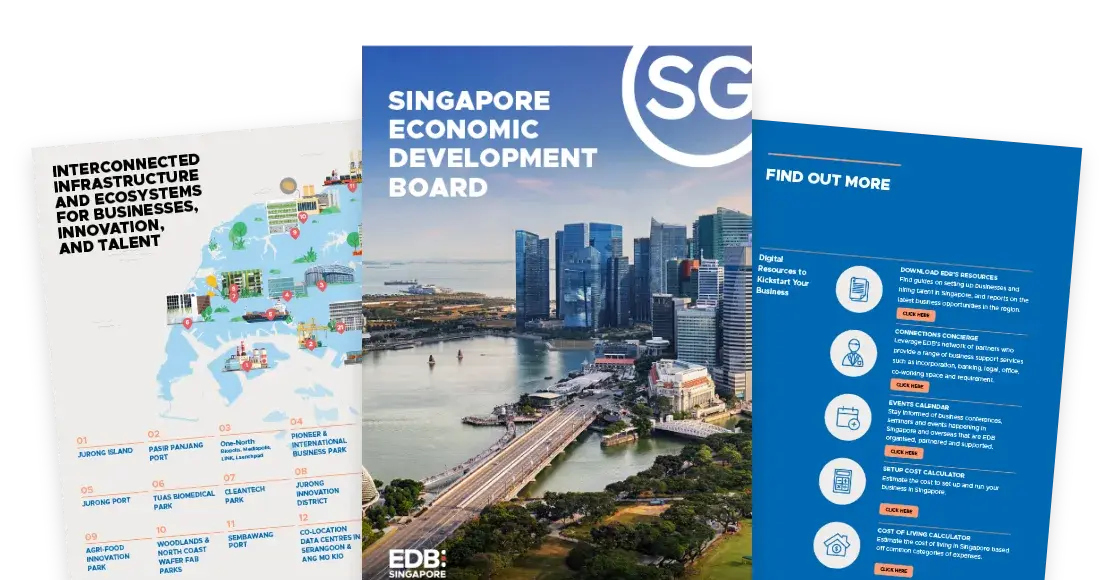
 

Read more about how Singapore can partner businesses in their advanced manufacturing journey in Asia


There is also the:

Advanced Remanufacturing and Technology Centre (ARTC): The ARTC acts as a bridge between research and real-world applications. Over 95 entities ranging from multinational corporations (MNCs) to startups have collaborated with ARTC to develop and deploy advanced manufacturing solutions. ARTC offers a model factory setting where companies can trial and refine their technologies – accelerating their journey from concept to commercialisation.

International Centre for Industrial Transformation (INCIT): This global organisation offers several tools – including internationally referenced frameworks and tools—to help companies deploy i4.0 technologies, increase productivity, and shape go-to-market strategies.

National Additive Manufacturing Innovation Cluster (NAMIC): NAMIC is Singapore’s national platform driving the adoption of digital and additive manufacturing technologies. NAMIC connects companies, researchers, and government partners to drive innovative research and practical applications — helping industries transform towards innovation and high value-added manufacturing.

Institute of Microelectronics (IME): A leader in semiconductor research, IME collaborates with industry and academia to develop technologies in advanced packaging, micro-electro-mechanical systems, and sensors. With state-of-the-art facilities, IME accelerates the commercialisation of semiconductor innovations.

Additionally, corporate innovation challenges such as the CapitaLand Sustainability X Challenge provide opportunities for businesses to solve industry challenges and expand their innovations into SEA. The CapitaLand programme awards 10 winners with up to S$1 million in funding to further develop and testbed their innovations at certain CapitaLand properties. Participating companies have the opportunity to receive funding and create new products that serve the SEA market, while companies that choose not to participate can still benefit from the availability of such technologies to improve efficiency at plants and factories.
 

2. A diverse pool of reliable contract manufacturers

Singapore's extensive network of contract manufacturers helps companies expand production capabilities, ensure compliance, and improve market responsiveness without substantial upfront investment. As the 5th largest exporter of high-tech exports globally, Singapore offers a thriving ecosystem for global manufacturers. By outsourcing some of their functions, global manufacturers can find cost-efficient manufacturing solutions and tap on the expertise of experienced contract manufacturers located here.

Here are some examples:

  • Accuron Technologies: Precision machining, process and equipment integration for aerospace, semiconductor, and commercial equipment sectors.
  • Advanced MedTech: Healthcare innovations and manufacturing services, including metal injection moulding and 3D metal printing.
  • Sunningdale Tech: Precision plastic components and turnkey plastic solutions, including mould design and fabrication.
  • Venture Corporation: Electronic manufacturing and technology solutions across design, product introduction, fulfilment as well as recovery and repair.
  • Meiban Corporation: Wide range of services, including mould fabrication, plastic injection moulding, and electronic manufacturing services.
  • NanoFilm: Specialises in nanotechnology-based coating solutions for the automotive, consumer electronics, industrial equipment and cleantech sectors.
     

Benefit from Singapore's pro-business environment and proximity to competitive manufacturing locations in Malaysia and Indonesia

3. A skilled workforce primed for transformation

With manufacturing being the largest component of the Singapore economy, the country has focused on ensuring a strong talent pool and pipeline. In 2021, one in every eight jobs in Singapore - or around 450,400 jobs - were manufacturing jobs. Industry Transformation Maps for key manufacturing sectors have focused on ensuring that workers have the relevant i4.0, tech and sustainability skills to take on roles in areas from additive manufacturing and robotics, to artificial intelligence (AI), to digitalisation and process engineering.

  • SkillsFuture Singapore: A government platform that provides courses and training for workers' lifelong learning and continual skills upgrading.
  • Industry 4.0 Human Capital Initiative (IHCI): This initiative helps companies develop and execute roadmaps for upskilling workers.
  • Global Ready Talent Programme: Helps businesses expand by building a pipeline of highly skilled global-ready talent.
  • ASEAN Leaders' Programme: Helps regional business leaders and C-suite executives connect with others in the region to better understand SEA markets for further expansion.

Learn how businesses can build their A-team in Singapore with its strong pool of local and global talent.

Singapore also offers additional government support to manufacturers to kickstart their journey and grow here.

  • Pioneer Industries (Manufacturing) Incentives (PC(M)): Encourages companies to engage in significant manufacturing activities that introduce advanced technology, skillsets or know-how to Singapore.
  • Development and Expansion Incentive for Manufacturing (DEI(Mfg)): Encourages companies to engage in high value-added manufacturing activities including setting up or expanding such existing operations in Singapore. 
  • Partnerships for Capability Transformation (PACT) scheme: Supports productivity improvements, knowledge transfer, and test-bedding of innovative solutions, including joint product development at the proof-of-concept stage.
  • Resource Efficiency Grant for Emissions Grant (REG(E)): Supports manufacturing facilities and data centres in undertaking projects that improve their energy efficiency and reduce emissions.

Discover how Singapore can accelerate your advanced manufacturing journey by downloading our Advanced Manufacturing Guide.

Topics
Advanced Manufacturing
Southeast Asia
Innovation

The latest business insights and news delivered to your inbox

A picture of 3 brochures advertising EDB