Best of both worlds: why Europe’s healthcare, automation and logistics firms are looking to Singapore and Johor

Best of both worlds: why Europe’s healthcare, automation and logistics firms are looking to Singapore and Johor

From Alcon to DSV and SICK, European companies are pairing Singapore’s connectivity, governance and innovation with Johor’s scale and operational depth to develop an integrated regional operating model.

Illustration of a handshake between Singapore and Malaysia, with national flags incorporated into the hands and the Singapore skyline in the background, symbolising cross-border cooperation and economic integration through the Johor-Singapore Special Economic Zone (JS-SEZ).

The 2025 EU-Asean Business Sentiment Survey revealed that European companies see immense opportunities in Southeast Asia and view it as a major contributor to global revenues. Indeed, the region is tipped to be the world’s fourth-largest market by 2030, fuelled by a growing consumer base, an increasingly sophisticated manufacturing ecosystem and connectivity that supports supply chain resilience.

Having an operating footprint that supports scale, resilience and speed to market is thus essential to long-term success. And as companies optimise their regional setups, the Johor-Singapore Special Economic Zone (JS-SEZ) is shaping up to be an ideal solution.

Through the JS-SEZ, companies get the best of both worlds, integrating Singapore’s global connectivity, strong governance, and deep talent and innovation ecosystems with Johor’s industrial capacity, land availability, and skilled workforce. The result is a more integrated model where different business functions can be placed where they are most commercially and operationally effective.

For European companies such as Alcon, DSV, and SICK, that model has already taken shape. They are continuing to anchor regional leadership, advanced manufacturing, engineering, quality oversight, and supply chain design in Singapore, while drawing on Johor’s proximity to support additional capacity, production depth, and operational flexibility.
1. How Sensor Giant SICK Scales in Southeast Asia
 
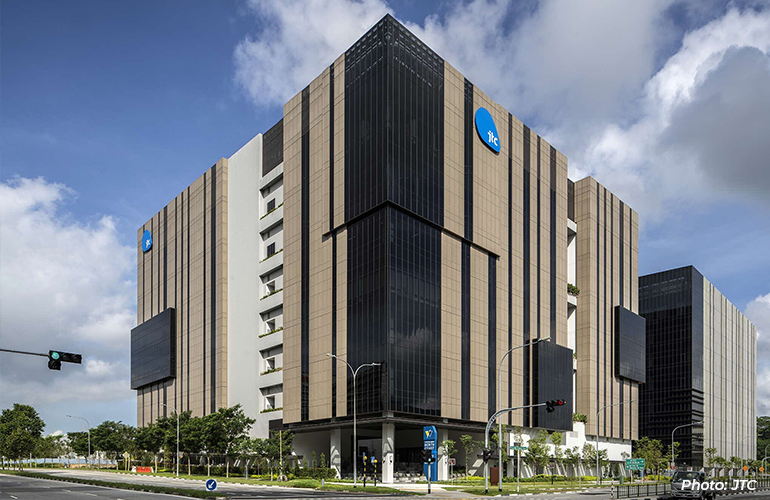
Exterior view of a modern JTC industrial facility in Singapore, featuring a multi-storey business park designed to support advanced manufacturing and technology operations.

SICK’s facility at JTC’s 1 North Coast industrial park

For SICK, the German sensor specialist whose products are used in the majority of the world’s international airports, the JS-SEZ bridges advanced manufacturing and production scale.

Mr Victor Phay, Vice-President of Research and Development (R&D) and Managing Director of SICK’s Product Center Asia, says Asia Pacific accounts for 20 per cent of its overall sales, and Singapore accounts for about half of the region’s share.

SICK chose to establish its Product Center Asia in Singapore, complementing its two other global centres in Europe and United States. In 2009, it also opened a small production facility, drawn by Singapore’s ease of doing business, structured business processes, and strong intellectual property protection.

Singapore holds a regional mandate and leads front-end product development, translating customer needs into product concepts and development. R&D also sits in Singapore, focusing on developing innovative sensors for customers in Asia, supported by the country’s deep competence and engineering talent in sensor innovation.

In 2011, SICK opened its production facility in Johor, which handles industrialisation, mass production and lifecycle management. This setup provides the necessary land, warehousing, operators, and a more cost-efficient operating base.

The logic behind this division of functions is clear and has delivered measurable scale. The value of proximity is not only about distance but also about the ability to move ideas, people, and production know-how across the border quickly.

Since then, operations have grown, and in 2025, SICK produced more than 10 million sensors through the twinning model.

Mr Phay says clear processes are needed to take a product from design and prototyping in Singapore to industrialisation and mass production in Johor.

“The closeness between the two teams is instrumental in this mode of collaboration,” Mr Phay says, adding that regular cross-site support and knowledge exchanges have taken place over the years.

For European companies evaluating the region, SICK offers a practical lesson: the business and supply-chain strategy must be clear from the start.

“With the current volatility defragmenting the global supply chain, the Singapore-Johor model offers some degree of certainty and calmness amidst the storm.”

Mr Victor Phay

Vice-President, Research and Development, Managing Director

PCS


2. Singapore Anchors Alcon’s Strategic Regional Growth
 
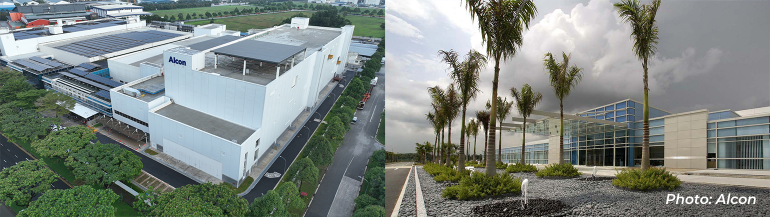
Side-by-side views of Alcon facilities in Singapore, featuring a large manufacturing site and a modern office campus surrounded by landscaped greenery and palm trees.

Left: Alcon in Tuas, Singapore. Right: Alcon in Johor, Malaysia.

For Swiss-headquartered eye care group Alcon, the Singapore-Johor model is about making sophisticated healthcare products at scale, without compromising quality.

Alcon produces products across vision care, surgical and ocular health, with manufacturing and technology hubs in Europe, the Americas and Asia.

Singapore is the centre of Alcon’s regional and manufacturing activities in Southeast Asia. Since 2005, the company has steadily expanded and invested in the city-state, reinforcing its role as a strategic hub.

Its expanded Tuas facility is one of its largest high-tech manufacturing sites, featuring advanced automation and smart manufacturing systems. It also supports global production of Alcon’s flagship contact lenses, which feature proprietary technologies. 

Alcon also operates facilities in Johor and Batam, which offer specialised production capabilities and complement Singapore’s regional operations.

Ms Michelle Dixon, Alcon’s Vice-President for Manufacturing and Technical Operations Management for Global Vision Care, describes this as a “complementary, cross-border cluster”.

In practice, Singapore leads manufacturing strategy, advanced engineering, quality oversight and regional coordination. Johor supports this with additional production capacity within close reach.

For companies in regulated sectors such as eye care and medical technology, this distinction matters because quality, compliance and operational standards must be consistent across sites.

By leveraging the JS-SEZ, Alcon says it can grow more efficiently, respond faster to changes in demand or supply, and avoid duplicating the same capabilities across different sites.

As Ms Dixon puts it: “A Singapore-Johor operating model allows companies to combine strategic control, governance, and innovation with operational scale and flexibility – all within a tightly connected ecosystem.”

For companies looking to grow in Asia while managing risk and complexity, she says this clustered approach can provide “both resilience and long-term competitiveness”.
 

“A Singapore-Johor operating model allows companies to combine strategic control, governance, and innovation with operational scale and flexibility — all within a tightly connected ecosystem. For organisations looking to grow in Asia while managing risk and complexity, this clustered approach can provide both resilience and long-term competitiveness.”

Ms Michelle Dixon

Vice-President, Manufacturing & Technical Operations Management

Global Vision Care


3. DSV’s Speed-and-Scale Logistics Model
 
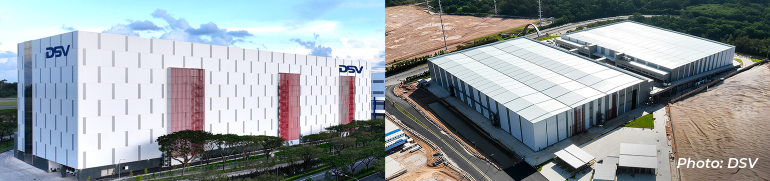
Side-by-side aerial views of DSV logistics facilities in Singapore, showcasing large-scale warehousing and distribution infrastructure designed to support regional supply chain operations.

Left: DSV's RedLion2 Hub in Singapore. Right: DSV's Medini facility in Johor

For Danish logistics group DSV, the Singapore-Johor model is about improving the speed, flexibility and resilience of regional distribution.

The company operates in more than 90 countries, with a global facility footprint of more than 17 million square metres.

Southeast Asia represents about 12 per cent of that footprint, underscoring the region’s growing importance.

Singapore was a natural choice for DSV’s regional headquarters because many multinational companies base their Asia-Pacific leadership, procurement and supply-chain teams here, says Mr Tan Ching Siow, DSV’s Senior Vice-President, Contract Logistics, Pacific cluster, and Managing Director of Contract Logistics in Singapore.

This allows DSV to plan, coordinate and adjust supply chain operations for customers across the region more quickly.

DSV does not see Singapore and Johor as competing locations. Instead, they are “two sides of the same coin”, says Mr Tan, with the JS-SEZ making it easier for companies to use both markets as one integrated logistics platform.

In Singapore, DSV’s RedLion2 hub and existing SLC3 facility span about 1.2 million square feet. These sites are designed for fast-moving goods that need quick turnaround, precise handling, and reliable connections to global markets.

Across the border, DSV’s Medini facility in Johor supports inventory storage, consolidation and regional staging. This gives customers more room to manage stock, support manufacturing flows, and plan for demand shifts.

Together, the two sites create what Mr Tan calls a “speed-and-scale” model.

For customers, this means high-demand inventory can be stored closer to Singapore for immediate distribution, while slower-moving or backup stock can be held in Johor to strengthen resilience.

This flexibility matters now more than ever when companies are rethinking supply chains.

“From instability in the Middle East and Red Sea shipping disruptions to broader geopolitical polarisation and trade fragmentation, how companies think about supply chains has been fundamentally reshaped,” says Mr Tan.

“Southeast Asia is emerging as one of the world’s most strategically important regions for global supply chains. Within Southeast Asia, the Singapore–Johor corridor presents a compelling operating model, combining Singapore’s stability, connectivity and regional leadership role with Johor’s growing industrial ecosystem and scalability within a tightly integrated cross-border network.”

Mr Tan Ching Siow

Senior Vice-President, Contract Logistics, Pacific Cluster Managing Director

Singapore DSV


The value of the JS-SEZ extends beyond market access or cost efficiency. It provides companies an opportunity to build an operating model for the region, anchored in the advantages of two neighbouring economies, and backed by proactive government support to eliminate cross-border friction. Learn how the JS-SEZ can make a difference to your business here.

Related Content

Subscribe Icon
The latest business insights and news delivered to your inbox
Subscribe now