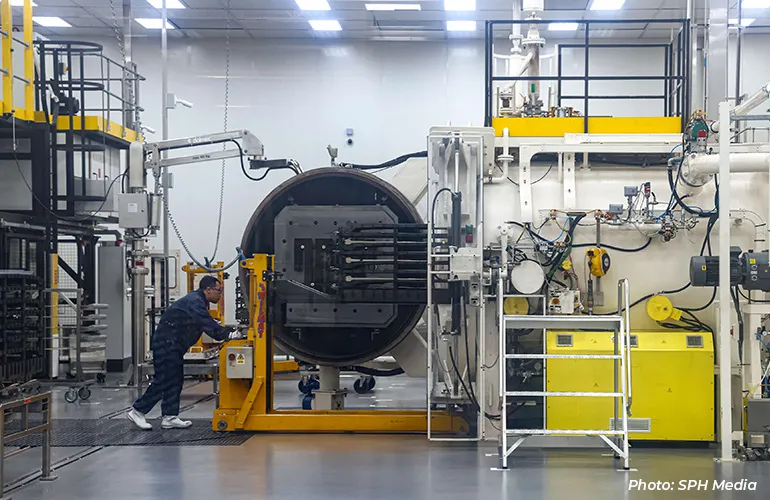
Thales’ Singapore teams focus on high-volume avionics manufacturing, producing about 11,000 units annually. These include flight control computers and displays for the Airbus A320, A330, and A350 families.
According to the latest data from the Singapore Economic Development Board, transport engineering was one of the faster growing sectors in December.
Output for transport engineering grew 20 per cent year on year in December, with the aerospace segment expanding 35.9 per cent, supported by higher production of aircraft parts and sustained maintenance, repair and overhaul jobs from commercial airlines.
The aerospace industry is responsible for about 20,000 jobs in Singapore.
Manufacturing, as a whole, remains a core pillar of Singapore’s economy, contributing about 20 per cent to its gross domestic product. The aerospace industry is one that the government has been trying to build since the 1960s following Singapore’s independence and the subsequent withdrawal of the British military.
The country’s flagship carrier, Singapore Airlines, was incorporated in 1972. An engineering division was later set up to support maintenance and repair works and this engineering arm went on to become SIA Engineering Company.
Civil aviation infrastructure
At the same time as Singapore built up its civil aviation infrastructure, ST Aerospace, now ST Engineering Aerospace, was founded in 1975 and developed defence-linked maintenance capabilities to support the country’s air force.
ST Engineering Aerospace subsequently branched out into the commercial sector to support airlines from its Singapore base, and later expanded overseas for global reach.
Joshua Ng, a director at Alton Aviation Consultancy, explained these developments, particularly that of SIA Engineering Company and ST Engineering Aerospace helping to anchor Singapore’s MRO capabilities.
Currently about 10 per cent of commercial aviation MRO is done in Singapore.
Yet Ng also noted that attracting companies to have manufacturing capacity in the city-state is necessary for Singapore to remain competitive as it becomes a higher-cost country. Manufacturing also allows the city-state to diversify its aviation operations as maintenance work is tied to fleet operations and utilisation cycles, while manufacturing is tied to aircraft and engine production cycles.
“Singapore focuses on the precision manufacturing of aircraft and engine components; these are high-value parts of the aircraft and require the workforce to have strong technical skills,” he said.
He added that precision manufacturing also has higher value-add, thus increasing the value-add per employee and value-add per area, which are important factors in land and labour-constrained Singapore.