Stripe moves head of global product to Singapore to drive Asia-Pacific growth

Stripe moves head of global product to Singapore to drive Asia-Pacific growth

Abhinav Tiwari also sees an opportunity to be part of Singapore’s development of stablecoin payments.


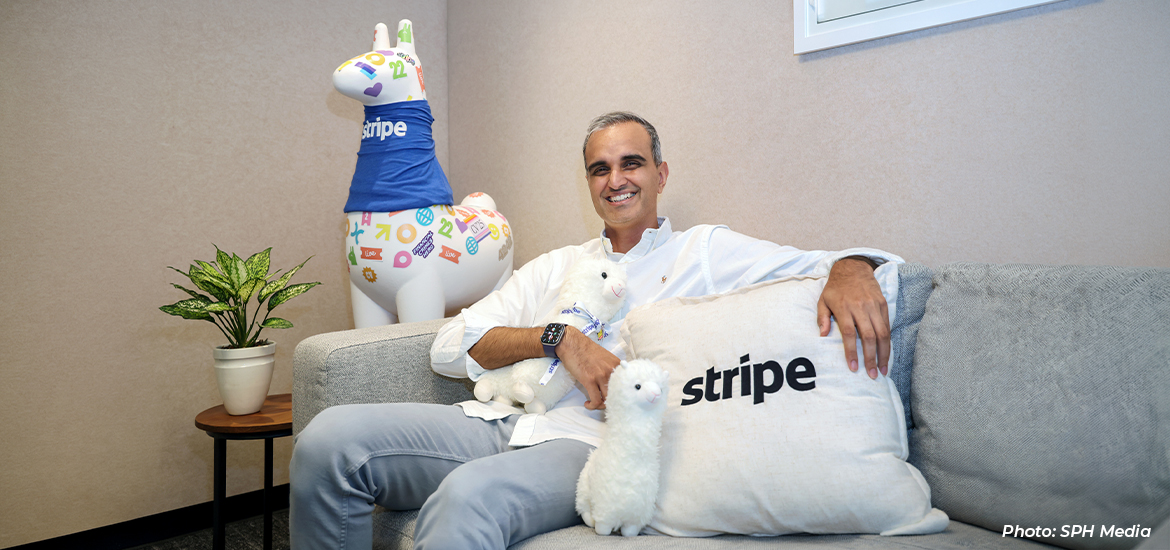
Portrait of a Stripe executive seated in a lounge area with branded décor and plush mascots, smiling in a relaxed office environment that reflects the company's workplace culture.

Stripe's head of global product Abhinav Tiwari said that being in Singapore will help Stripe better serve its clients in the region

The US-founded payments and financial services company Stripe is placing a key leadership role in its Singapore office to drive its Asia-Pacific business and growth from the region.

Abhinav Tiwari, who has been shuttling between Singapore and Seattle in the first five months of the year, will now be located in Singapore permanently to be closer to Stripe’s customers in the region.

“Proximity helps. Like being able to call a customer and not be on the West Coast of the US or being able to go see a customer face-to-face and ask them what’s going on so that we can make those changes for our product,” Tiwari said.

He said that Stripe identifies Asia, particularly Southeast Asia, as a region that represents the most complexity both in terms of payment methods and operating environment.

The 41-year-old, who was promoted to become Stripe’s head of global product at the start of this year, added that his move to Singapore is “reflective of growth in the region, but also of what’s to come”.

Tiwari revealed that, for example, he and his team have been working on a product with GCash, the largest e-wallet in the Philippines, that is expected to launch by the end of June.

He added that Stripe is also the payment provider for many “scale-up AI companies” and cited Manus AI as a client Stripe works with. In recent years, Singapore has also become a base for AI startups to expand either regionally or internationally.

Stripe built its business on providing programmable solutions that helped merchants and developers manage transactions, billings, and fight fraud.

In Asia, Tiwari said that he sees opportunities to further develop Stripe’s multi-currency presentment and settlement, and adaptive pricing offerings for the Asian market. These solutions deal with cross-border transactions.


The volume of cross-border payments in Asia is expected to rise to 23.8 billion in 2032, up from the 12.8 billion in 2024, according to a report from the International Monetary Fund.

Stripe was founded by two Irish brothers, John and Patrick Collison, in Palo Alto, California, in 2010. The payments and financial services company now processes over US$1.9 trillion (S$2.5 trillion) of payments annually and has become one of the largest and most valuable private firms.

Stripe is dual-headquartered in both the US and Ireland, and its Singapore office serves as regional operations and engineering hub. The company entered Singapore in September 2016. Stripe’s clients in Asia now include Luckin Coffee, MiniMax, and StarHub.

The company said that Tiwari being in Singapore would lead to an expansion of the team in the city-state but declined to reveal specific numbers and said that it would be at least in the double digits.
 

Stablecoins

Apart from driving growth for Stripe in Asia, Tiwari said that Stripe is also keen to partner with the government to facilitate the use of stablecoins in Singapore.

Stablecoins are digital currencies that are pegged to an asset, which is usually a fiat currency, meaning that the value of these stablecoins are less prone to volatility compared to digital currencies like Bitcoin or Ethereum.

Currently, about 98 per cent of the stablecoin market is made up of US dollar-pegged crypto assets, but notable use cases have been emerging in Southeast Asia through remittance corridors and corporate treasury management.

Transacting with stablecoins through blockchain technology would increase speed and lower fees associated with traditional banking processes.

Stripe already has solutions that allow users to accept stablecoin payments and settle these payments in US dollars. In Singapore, Stripe is part of Project Bloom, an initiative by the Monetary Authority of Singapore, Singapore’s central bank, to extend settlement capabilities offered by financial institutions.


Project Bloom caters to the growing interest among private sector participants in tokenised bank liabilities and well-regulated stablecoins as settlement assets and encompasses multiple currencies, domestic and cross-border payments, and wholesale use cases.

Members involved in Project Bloom include DBS, Southeast Asia’s largest bank. The Singapore bank, like Stripe, has also been developing offerings around stablecoins.

The Singapore government is one of the most advanced in the region when it comes to regulating and enabling the use of stablecoins.

“Stablecoins are going to be an absolute game changer in the financial technology industry,” Tiwari noted. “We are really keen to partner with the Singaporean government, and I think it’s really important for this to not just be an American thing but also something that is available to business here.”
 

Source: The Business Times © SPH Media Limited. Permission required for reproduction.

Related Content

Subscribe Icon
The latest business insights and news delivered to your inbox
Subscribe now