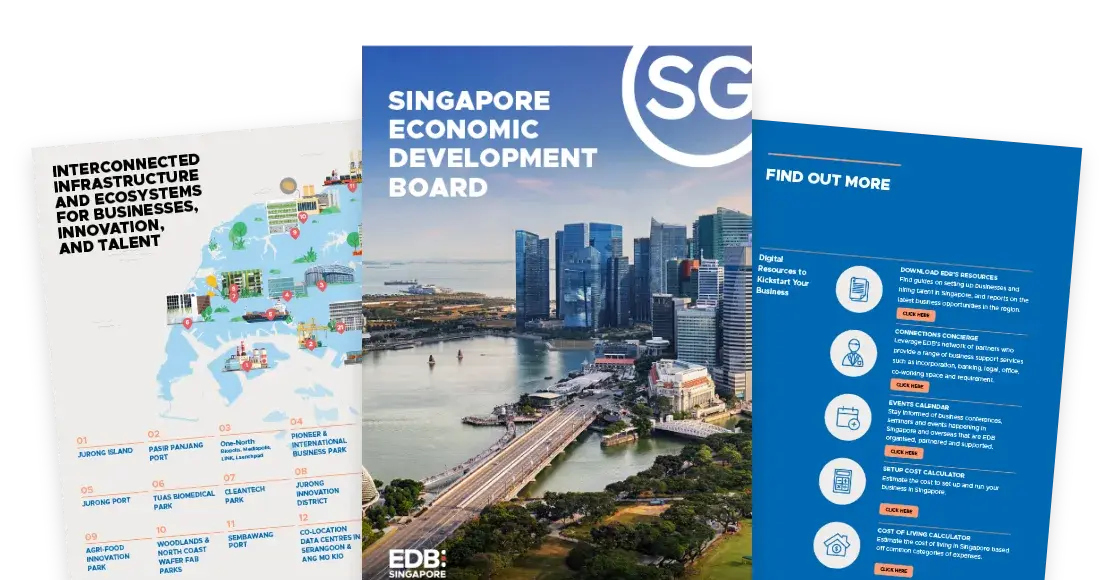
Read the guide
Find the information you need all in one place, including your lifestyle needs in Singapore like the healthcare system, transportation and more.
Singapore, a city of around 6 million, has about 1.86 million non-residents, including expats and foreigners working here^. A global city in the heart of Asia, it offers its residents a high quality of life, a top-notch business ecosystem, and strong connectivity to the rest of the world.
If you are considering joining them, you likely want to understand what makes Singapore's Asia's premier destination for international professionals and families.
Is Singapore truly a good place to live? What are the living costs? Will my children thrive here?
We have put together an essential guide to answer your questions.
Read to find out:
* Guide to Living in Singapore may not be reproduced in any form whatsoever without the prior written permission of EDB. View more details in our terms of use.
^ As of June 2024, Population in Brief report, National Population and Talent Division (NPTD)
% ECA International, Singapore still most liveable location for expatriate workers from East Asia, 8 February 2023
Read the guide
Find the information you need all in one place, including your lifestyle needs in Singapore like the healthcare system, transportation and more.
Singapore is recognised for its high quality of life, personal safety, efficiency, vibrant culture, and fantastic food. These are all among the top reasons expats like living in Singapore. With its strategic location in the heart of Southeast Asia and world-class infrastructure, Singapore offers excellent regional connectivity for both business and leisure.
Singapore’s consistent governance and overall stability support long-term planning, making it a good place to live.
Asia’s most liveable city
Singapore ranked first in Asia in the Quality of Living Ranking in 20241, recognised for its clean and well-maintained environment, strong healthcare standards, reliable public services, and overall stability.
The city-state also boasts a stable and robust economy, well-maintained infrastructure, and convenient connectivity to the region. Working expats enjoy a high standard of living in Singapore, and the cosmopolitan, international atmosphere makes it an easy place to adapt to.
One of the safest cities globally
Singapore ranks among the safest cities globally, and is the safest in Southeast Asia2. This commitment to safety translates into tangible daily experiences – around 98 per cent of residents report feeling safe walking alone at night compared to the global average of 73 per cent3. This reflects the genuine, lived experiences of safety that define everyday life in Singapore.
With one of the lowest crime rates, many expats emphasise the freedom to walk, commute or use public spaces at any hour without fear. Public spaces are well-maintained, and the rule of law is consistently respected and enforced.
Singapore also benefits from natural stability. Positioned outside major fault lines means the city-state is spared from natural disasters such as earthquakes, volcanic eruptions, and typhoons that affect neighbouring regions. Additionally, emergency services maintain preparedness for any unexpected incidents.
Competitive and progressive personal income tax regime
Singapore’s personal income tax regime is designed to be competitive and progressive, while supporting social objectives such as families, parenthood, and retirement adequacy. Personal income tax rates range from 0 to 24 per cent and are applied on a progressive basis4 – meaning higher earners contribute proportionately more, while maintaining overall competitiveness.
Unlike many other countries, Singapore operates without a capital gains tax system, benefiting investment activities and entrepreneurship. Additionally, dividend earnings remain tax-free. For the latest information on Singapore's tax framework, visit the Inland Revenue Authority of Singapore’s website.
Climate and air quality
Singapore’s tropical climate maintains an average daily temperature of 25 to 31.6 degrees Celsius5, supporting an outdoor lifestyle throughout the year. The city avoids extreme temperature swings or harsh winters, allowing residents to enjoy outdoor activities across seasons. While rainfall occurs frequently due to Singapore’s equatorial location, it typically remains brief and predictable, making daily planning straightforward with simple preparations such as carrying an umbrella.
During midday hours, temperatures can feel warm and humid. In response, Singapore has developed extensive infrastructure connecting transport hubs, schools, shopping centres, and residential areas through comprehensive sheltered walkway networks. These accessibility-friendly pathways often feature innovative heat mitigation solutions, including hydrogel walkways, green roofs and facades, and fine misting systems.
Singapore’s air quality further enhances living standards, remaining within good to moderate ranges for approximately 99.5 per cent of the year, outperforming many other Asian cities6. This achievement stems from some of the region’s strictest air pollution controls, the absence of heavy industrial pollution, and favourable coastal winds that effectively disperse airborne pollutants.
Although Singapore occasionally experiences seasonal haze, these episodes remain intermittent and temporary, rather than regular occurrences. Strong environmental governance and proactive air quality management ensure that everyday conditions remain conducive for daily activities. Consequently, residents can confidently maintain active lifestyles, including outdoor exercise and enjoying public spaces year-round.
Together, these factors contribute to a high quality of life in Singapore.
Download the full Guide to Living in Singapore for more details on day-to-day living here, including getting around, leisure activities, and more.
Singapore is home to top-ranking universities and tertiary institutions, and has one of the world's finest primary and secondary education systems. This makes it particularly attractive for families with children.
Singapore’s education system
For families considering relocation, Singapore offers a world-class education system. From preschool through to university, there is a strong focus on core academics and character development. Residents benefit from an extensive range of world-class education options, from international schools to local pathways. School campuses maintain high safety standards whilst offering modern, well-equipped facilities.
Singapore’s students consistently achieve top global rankings in mathematics, reading, and science, according to PISA (Programme for International Student Assessment) rankings7. These results reflect the system’s strong academic foundations and emphasis on critical thinking.
International schools for every curriculum
Singapore hosts over 60 international schools providing education from pre-school through secondary school, with curricula aligned with overseas education systems, such as International Baccalaureate (IB), International General Certificate of Secondary Education (IGCSE), and American or British programmes. Expat families seeking continuity with home country systems will find excellent options readily available.
Students in Singapore develop within a highly multicultural, multilingual environment where English is the main language of instruction. Many students also receive opportunities to learn second languages, such as Mandarin, Malay, or Tamil. This environment actively encourages cultural awareness, resilience, and global readiness.
Clear post-secondary and university pathways
Singapore provides well-defined post-secondary education pathways through polytechnics, specialised institutions, and autonomous universities. These institutions offer academic, technical, and applied programmes, many closely linked to industry requirements through internships, work-learn programmes, and partnerships with employers.
At the university level, Singapore is internationally recognised for higher education excellence. For example, the National University of Singapore (NUS) and Nanyang Technological University (NTU) both sit among the world’s top 15 universities8, reinforcing Singapore’s strong reputation for tertiary education.
Lifelong learning and continuous skills development
Education in Singapore extends well beyond formal schooling. Lifelong learning is strongly supported, with continuing education and training opportunities available for working professionals and adult learners. These programmes enable individuals to reskill, upskill, or deepen expertise in response to evolving industry demands.
Singapore offers extensive executive education and professional development programmes, spanning leadership development, business strategy, digital transformation, and data analytics. These programmes are delivered by prestigious institutions such as INSEAD, NUS Business School, NTUC LearningHub, and SMU Academy, designed to support working professionals at various career stages, including expatriates based in Singapore.
This strong culture of continuous learning supports professionals throughout their careers, reinforcing Singapore’s reputation as a destination where education and personal development receive priority attention.
Whether relocating with young children, planning educational journeys, or seeking personal and professional development opportunities, Singapore offers a comprehensive and high-quality education ecosystem. The combination of strong public education, highly regarded international schools, and lifelong learning opportunities makes Singapore a compelling place to live for families and professionals alike.
The complete Guide to Living in Singapore includes detailed information on school types, fee structures, and admissions processes for international students.
Expats living in Singapore can access an internationally recognised, top-ranking healthcare system.
Healthcare in Singapore – one of the best globally
Singapore’s hospitals and medical facilities consistently rank among the best in the world9. Significant investments in medical research, education, and technology enhance operational efficiency and foster innovative treatments.
Singapore’s healthcare infrastructure includes both private and public hospitals, private general practitioner (GP) clinics, government polyclinics, and dental practices – all staffed by highly trained and qualified medical professionals10. The public healthcare system is accessible to everyone, though health subsidies are primarily for citizens and permanent residents.
Do I need health insurance in Singapore?
Most employers in Singapore offer health insurance as part of their benefits package. For additional peace of mind, global insurance firms based in Singapore can provide additional medical insurance coverage. Expats are not legally required to have health insurance, but are strongly advised to obtain coverage for comprehensive protection.
The complete Guide to Living in Singapore includes further details on navigating the healthcare system in Singapore and understanding your insurance options.
As a leading financial, trade, and transport hub, Singapore provides an exceptional environment for career development and business establishment, attracting professionals and entrepreneurs from around the globe.
Why Singapore is a strong base for your career or business?
Singapore is a dynamic economic powerhouse, positioned at the crossroads of the world’s major trade, shipping, and airline routes. The economy is highly competitive and diversified, spanning technology, biomedical sciences, advanced manufacturing, financial services, and more.
Living in Singapore positions you at the heart of Southeast Asia and the Asia-Pacific region. This strategic location has convinced many international companies to establish headquarters here, benefiting from the global connectivity, a pro-business environment, access to highly skilled, competitive talent, and world-class infrastructure.
These factors combine to make Singapore an attractive destination for career building and long-term professional development.
Visas and work passes in Singapore
All foreign nationals working in Singapore will require a visa or work pass. Various work passes and visas are available for individuals, couples, and families, depending on your profile and circumstances. For example, the Overseas Networks & Expertise (ONE) pass targets top talent in business, arts and culture, sports, academia, and research.
Singapore’s corporate income tax rates
Singapore has competitive tax rates for both personal income and business operations. Corporate tax rates are a flat 17 per cent for both local and foreign companies. Often, this rate can be further reduced by partial tax exemptions, incentives for startups, and available rebates.
The tax system is straightforward, and filing can be done easily online.
Learn more about Singapore’s business-friendly tax regime.
Cost of living in Singapore
The favourable tax environment makes Singapore a good place to live. While rental costs reflect the land-scarce city-state's premium location, everyday living expenses in Singapore need not be expensive with the availability of affordable options for dining, public transportation, grocery shopping, and numerous other necessities. Learn more about what it really costs to live in Singapore.
Singapore's compact design ensures most residential areas remain easily accessible through public transportation and a well-maintained road network, offering diverse housing options to match various preferences and budgets.
Accommodation in Singapore
The main housing types in Singapore include public housing by the Housing and Development Board (also known as HDB flats), private condominiums, and landed properties. Approximately five to six per cent of homes consist of standalone houses or bungalows with gardens, referred to as landed properties in Singapore11.
Most expats living in Singapore choose to rent a furnished or unfurnished condominium, many offering shared amenities such as swimming pools, gyms, and outdoor recreational areas.
Residential areas throughout Singapore maintain excellent accessibility. Consider proximity to workplaces, schools, and leisure activities when selecting accommodation. As with any relocation, choosing the optimal location for your lifestyle remains crucial.
Popular neighbourhoods for expats in Singapore
In the central district, neighbourhoods such as Holland Village, Orchard Road, and River Valley offer convenient access to shopping, dining, and entertainment venues. Bukit Timah attracts many due to its proximity to numerous international schools and green spaces.
Many French and Australian expat families favour housing around Serangoon because of the nearby French and Australian international schools. Similarly, American families often prefer the northwest’s Woodlands area with its shopping centres, green spaces, and proximity to the Singapore American School.
Short-term accommodations in Singapore
If you need more time to explore Singapore's neighbourhoods before making long-term commitments, serviced apartments and co-living spaces offer high-quality, short-stay options in convenient locations around the city. These serve as a practical solution whilst you familiarise yourself with Singapore and determine optimal arrangements.
Can foreigners buy property in Singapore?
Foreigners are eligible to buy property in Singapore, although approval from the Singapore Land Authority (SLA) is required for selected property types under the Residential Property Act12.
In addition to property costs, buyers are required to pay Buyer’s Stamp Duty, which applies to all property purchases in Singapore. These requirements help ensure a well-regulated property market while providing clear guidelines for foreign buyers considering property ownership.
The Guide to Living in Singapore covers the rental process step-by-step, including tips for renting in Singapore, rental price comparisons, and information on foreign ownership of property.
Singapore is well-connected to the region. Within the city-state, commuting is affordable, and technology enhances travel by train, bus, or car.
Singapore – a smart city
Singapore ranks 1st in Asia and 9th globally in the IMD Smart City Index 202513 – driven by its use of technology that enhances daily life. With fast broadband, real-time transport updates, digital ID via Singpass, and widespread cashless payments, the city is built for smart and connected living.
Expats benefit from seamless digital services like appointment booking, bill payments, and pass renewals. Combined with efficient public transport and smart neighbourhood design, daily life is convenient, safe, and well-connected.
Public transport in Singapore
Singapore’s public transport network is efficient, affordable, and easy to navigate. The public transportation network here includes the Mass Rapid Transit (MRT) system, Light Rail Transit (LRT) system, taxis, and buses.
The MRT system spans over 140 stations, operating daily from 5:30 am to midnight. During peak hours, trains arrive every two to three minutes, while off-peak frequency is around five minutes. Bus routes align with the train network, and all buses are wheelchair accessible.
Technology enhances integration across various transport modes. Passengers navigate using real-time information through mobile applications and station displays. Smart ticketing systems like the EZ-link card enable seamless tap-on and tap-off functionality across trains and buses. Transportation is safe, efficient, and extremely user-friendly.
Driving to get around and car ownership in Singapore
Driving in Singapore is efficient, with well-maintained roads. However, car ownership is regulated to reduce congestion, and the city-state offers excellent alternatives. These include car-sharing platforms, car clubs, carpooling, and short-term car rentals ranging from a few hours to full days. These services are typically accessed and paid for through an app.
Foreign residents can drive on an International Driving Permit or a valid foreign license for the first 12 months. After residing in Singapore for 12 months, foreign licenses must be converted to Singapore licenses.
A gateway to the region – by air, land, or sea
Singapore’s Changi Airport is consistently ranked among the world’s finest airports. It serves as a gateway for business and leisure travel with over 100 airlines operating more than 7,400 weekly scheduled flights14. The airport itself also offers exceptional shopping and entertainment experiences.
A four-hour flight covers most of Southeast Asia, and a seven-hour flight will cover most of the Asia-Pacific destinations. For weekend getaways, destinations like Bali, Langkawi, Phuket, and Vietnam are just short trips away. Ferry services connect Singapore to destinations like Bintan and Batam islands. The Johor-Singapore Causeway and Second Link provide road access to Malaysia for day trips and extended holidays.
Download the Guide to Living in Singapore for a full overview of the public transport system in Singapore, as well as nearby travel destinations.
Singapore presents a genuine tapestry of cultures, languages, and global influences, which is reflected in its rich heritage and culinary delights. This creates a truly unique living experience.
Why is Singapore’s culture unique?
Singapore's geography and history have nurtured a unique mix of ethnicities and languages. Among the Singaporean population of 4.18 million citizens and permanent residents in 2024, 74 per cent are Chinese, 13.5 per cent are Malays, 9 per cent are Indian Tamils, and 3.4 per cent represent other ethnicities15.
This multiculturalism manifests in Singapore's celebration of 11 public holidays, which include major religious festivals for Buddhism, Taoism, Islam, Christianity, and Hinduism. This reflects the city’s unwavering commitment to harmony and diversity, creating an inclusive environment for residents from all backgrounds.
Languages spoken in Singapore
While Malay serves as Singapore's national language, English, Mandarin, Tamil, and Malay all maintain official language status. English is the working language and is used in schools, business, government, and on road signs throughout the city, ensuring seamless communication for international residents.
Diverse food culture
Incredible cuisine consistently ranks among expats’ top ten reasons for choosing Singapore16. The culinary scene reflects Singapore’s multicultural society, blending Chinese, Indian, Malay, and Western influences into a unique culinary tapestry. Here, you can find a vast choice of authentic cuisine from around the world. Delicious must-try dishes include laksa, Hainanese chicken rice, char kway teow, roti prata, and countless other local specialities.
Hawker centres are open-air food courts with individual stalls serving freshly prepared, affordable local meals. They form an integral part of daily life and are central to local food culture, offering affordable and authentic street food, some of which has even earned Michelin star recognition. Singapore’s hawker culture is also recognised by the United Nations Educational, Scientific and Cultural Organization (UNESCO) as an Intangible Cultural Heritage of Humanity17. Beyond hawker fare, you will find everything from fine dining to casual international restaurants and speciality coffee shops.
Exploring Singapore’s nature
Despite its urban density, Singapore is designed as a “City in Nature”. Trees and lush tropical greenery are everywhere, even indoors! Skyscrapers and futuristic architecture define Singapore's famed skyline, but look closer, and you will see greenery on vertical walls and rooftop gardens on buildings that demonstrate the city’s commitment to sustainability.
The UNESCO-listed Singapore Botanic Gardens and the award-winning Gardens by the Bay are among the most photographed locations. With hundreds of parks, nature reserves, mangroves, tidal flats, and coral reefs, Singapore provides an ideal environment if you want to stay connected to nature while enjoying urban comforts and convenience.
Arts, entertainment, and staying active
Singapore has an exciting calendar of arts, music, and cultural events, including the Singapore International Festival of Arts, Art Week, and other annual events. The 55,000-seat Singapore National Stadium hosts international concerts and sporting events, and the Formula 1 Singapore Grand Prix draws motorsport fans from around the world each September.
For those prioritising an active lifestyle, government-backed initiatives aim to make fitness more accessible to everyone living in Singapore. Organisations like ActiveSG promote sport participation, providing information on venues, bookings, and classes for sports and fitness activities.
The city-state has over 500 gyms around the city18, numerous swimming complexes, and opportunities for water sports like kayaking, canoeing, and sailing. Running and cycling are popular, with extensive trails including the new 24-km Rail Corridor and the Park Connector Network linking green spaces across the island.
After-dark leisure and nightlife
Singapore transforms after dark, offering diverse nightlife and evening experiences beyond the typical club scene. From world-class nightclubs and rooftop bars with spectacular skyline views to intimate cocktail lounges and live music venues, there is something to suit different lifestyles and preferences. The city is also home to award-winning bars that are consistently ranked among Asia’s best19, alongside vibrant neighbourhoods where late-night dining, social gatherings, and cultural experiences continue well into the evening.
Beyond nightlife venues, Singapore’s after-dark attractions include river cruises, night markets, illuminated city landmarks, and distinctive experiences such as the Night Safari. These offerings operate within a safe and well-regulated environment, supported by an efficient public transport network that makes travelling at night convenient and reliable.
Download your comprehensive Guide to Living in Singapore
Whether you are a young professional seeking career development opportunities, a senior executive, investor, or entrepreneur, Singapore offers compelling reasons to begin an exciting new chapter in life.
This Guide to Living in Singapore, curated by the Singapore Economic Development Board, provides comprehensive information on housing, healthcare, education, transport, culture, and more – everything you need to make an informed decision and plan your move with confidence.

Referenceskeyboard_arrow_down