Chip players in Singapore ride AI wave to bump up investments in semiconductor ecosystem

Chip players in Singapore ride AI wave to bump up investments in semiconductor ecosystem

Applied Materials is the latest firm to expand operations in Singapore, citing similar ventures by customers.


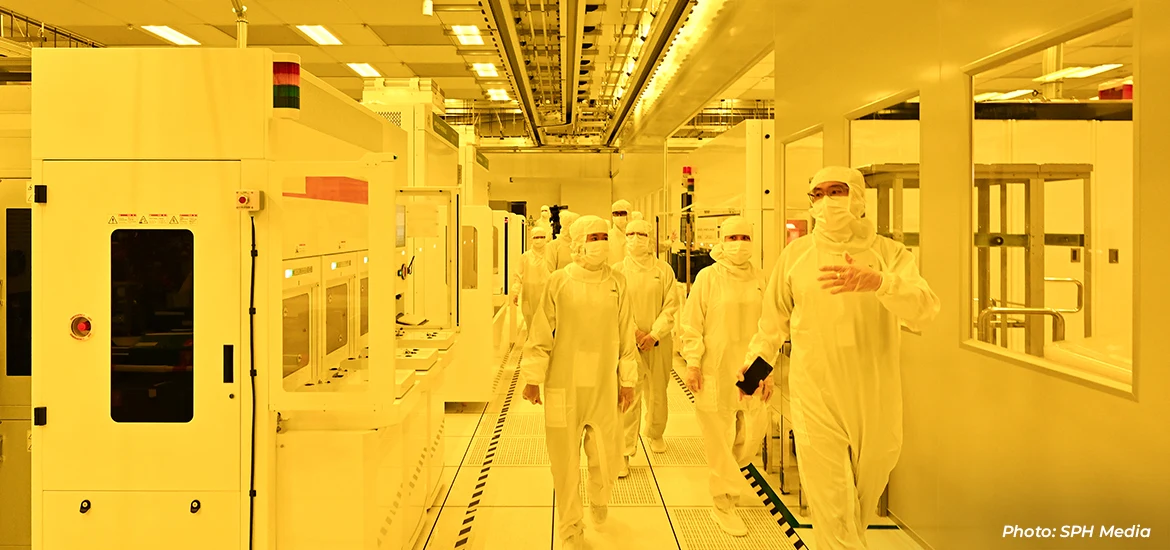
People in cleanroom suits walking through a semiconductor manufacturing facility.

UMC unveiled a new advanced fab expansion in Singapore in 2025. It is one of the many semiconductor firms that have invested in Singapore in recent years.

Economies such as South Korea and Taiwan may have been in the news over at least the last 18 months for benefiting from demand for hardware that powers artificial intelligence applications.

But Singapore – like them – has also been riding the AI wave. 

While Singapore may not have a home-grown semiconductor company equivalent to that of Taiwan Semiconductor Manufacturing Co or SK Hynix, it has a comprehensive semiconductor hub that is allowing it to benefit from AI-driven demand in this current semiconductor up-cycle.

This has had a positive impact on both its exports and the investments it has drawn in.

“Even though Singapore is not the main location for advanced node wafer production, it benefits from AI-driven demand through memory, advanced packaging, equipment, and high-reliability mature and specialty nodes,” said Lin Feng-wen, analyst at Taipei-based consultancy Isaiah Research.

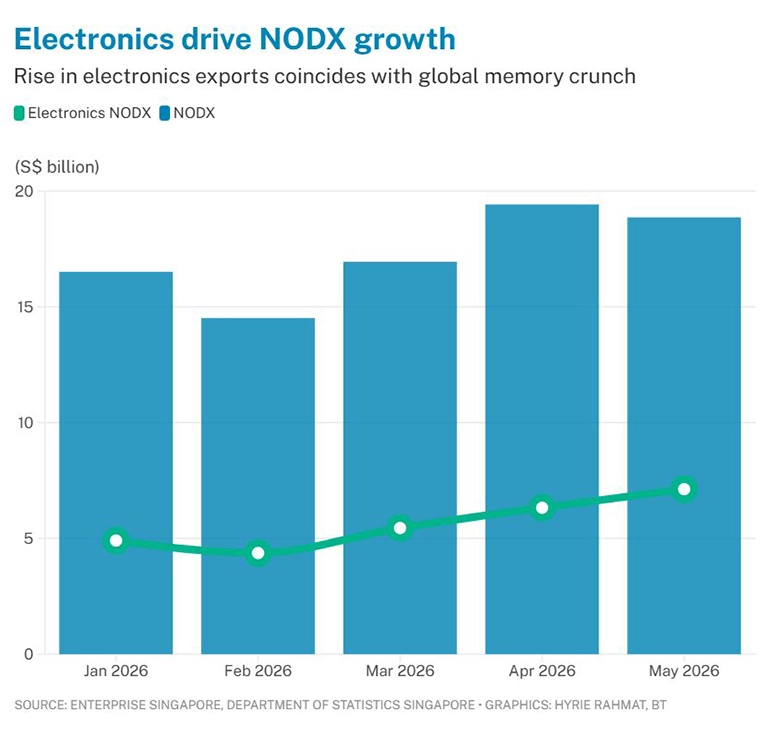
Recent data released by Enterprise Singapore revealed that electronics shipments have been driving its non-oil domestic exports (NODX).

NODX is a key economic metric that measures the total value of goods produced in Singapore and exported, excluding all oil and petroleum products, and is used as a measure of the health of its manufacturing sector and overall economic growth.

In May, Singapore’s NODX expanded 38.4 per cent from the same period the year before.

Electronics exports surged 94.8 per cent year on year, supported by robust AI-related demand, driven mainly by integrated circuits, disk media products, and PCs.


Singapore’s NODX and its electronics NODX have been expanding since the start of this year. The measures showed growth even in February – the month that Chinese New Year fell in this year.

The semiconductor industry typically slows down around the Chinese New Year period as economies such as Taiwan and China, which have huge semiconductor manufacturing facilities, observe the holiday.
 

Electronics drives NODX growth graph

The rise of Singapore’s electronics NODX coincides with strong demand for memory chips.

Micron, the American memory maker, has a significant manufacturing footprint in Singapore.

Outsourced semiconductor assembly and test players such as ASE Group are also present in Singapore  – these offer chip-packaging expertise that can be used for several types of chips, including memory.

The company reported revenue of US$41.5 billion (S$53 billion) for the three months ending 28 May, more than four times the US$9.3 billion in the same period the year before.

Micron’s NAND revenue reached US$9.9 billion, representing 24 per cent of its overall quarterly revenue. Singapore is Micron’s NAND centre of excellence and produces around 98 per cent of the chips for this segment. NAND is a type of memory chip that also enables AI as it provides long-term high-speed storage.

“Singapore and semiconductors are an interesting topic as part of this AI trend,” said MS Hwang, research director at tech market research firm Counterpoint Research.

He explained that while the country has no native “dominant leaders”, it is a strategic semiconductor hub that hosts diverse facilities across memory, foundry, automotive, power, and advanced packaging.

“Singapore has built a complete ecosystem anchored around major manufacturing fabs like Micron and GlobalFoundries,” noted Hwang.

Growing ecosystem

That ecosystem has been benefiting from a flurry of investments in recent years, against the backdrop of surging demand for chips.

In early June, American equipment maker Applied Materials expanded its operating capacity in Singapore with a new US$500 million campus. The facility aims to serve chipmakers that are expanding production to meet growing AI-driven demand. 

“We have customers investing here for chip technologies (and) customers investing here for packaging technologies,” said Applied Materials CEO and president Gary Dickerson.
 

 Gary Dickerson, CEO and president of Applied Materials.

Gary Dickerson, CEO and president of Applied Materials, says the expansion in Singapore is partly to serve customers that are also expanding operations in the country.

Applied Materials provides manufacturing equipment, services, and software used by chipmakers to produce many of the world’s semiconductor chips and advanced displays. Its Singapore expansion follows a string of major investments or expansions in the last three years.

Earlier this year, Micron said it was committing US$24 billion to boost its NAND capacity in Singapore. It has also been building a US$7 billion advanced packaging plant to produce dynamic random-access memory, or DRAM, chips in the country.


Besides players in the memory business, others in the supply chain, such as Taiwan-headquartered foundry UMC and fellow American equipment supplier Pall, have announced significant expansions of their Singapore operations.

Spokespersons from both UMC and Pall said Singapore’s comprehensive local semiconductor ecosystem and proximity to customers were among key factors in their expansion plans.

“Singapore’s strategic location, stable operating and business climate, and robust pipeline of engineering talents have made it an ideal location. In addition, strong support from the government has also been invaluable in helping UMC foster supply chain partnerships,” a UMC spokesperson noted.
 

Source: The Business Times © SPH Media Limited. Permission required for reproduction.

Related Content

Subscribe Icon
The latest business insights and news delivered to your inbox
Subscribe now