The Singapore difference
From Siemens to Hyundai, multinationals have established innovation centres and R&D hubs in Singapore to turn high-end research into scalable applications with real impact.
For Iain McLaughlin, Coca-Cola’s president of global commercial product supply, the company’s Singapore concentrate manufacturing plant serves as a proving ground for data, automation and AI in its operations. The plant’s success in raising productivity and cutting emissions has been recognised by the World Economic Forum, which named it a Global Lighthouse Factory. “Singapore allows us to pilot new production, planning and quality processes in a highly controlled yet globally connected environment,” says Mr McLaughlin.
What sets Singapore apart from other regional hubs looking to attract MNC investment is not innovation itself, but the conditions that help large firms move from experimentation to execution.
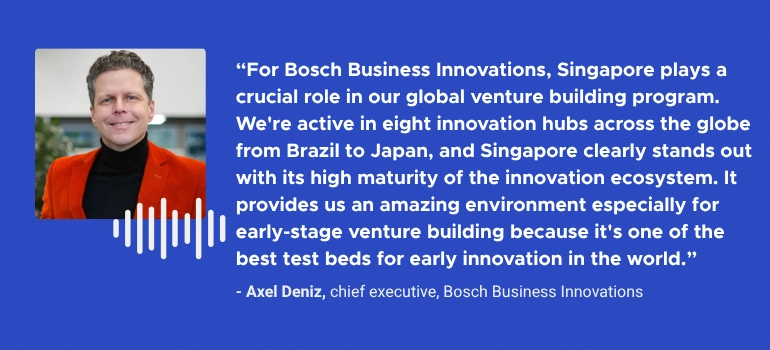
“One of the most important aspects of building new ventures is matching the speed of the market,” says Mr Deniz. “If you’re a large company, you’re usually moving too slowly, putting you at a disadvantage to non-corporates and startups.”
Bosch learned this in its early years of establishing its innovation hub in Singapore, when it tried to build new ventures in-house. “We built around 15 projects and maybe five moved to the pilot stage, but none of those exist anymore,” says Mr Deniz. “What we learned from that experience was the importance of validating ideas quickly — and of building the right structure around them: one that is agile, capital-efficient, founder-led, and free from corporate bureaucracy and politics, so the venture is ultimately investable in the market.”
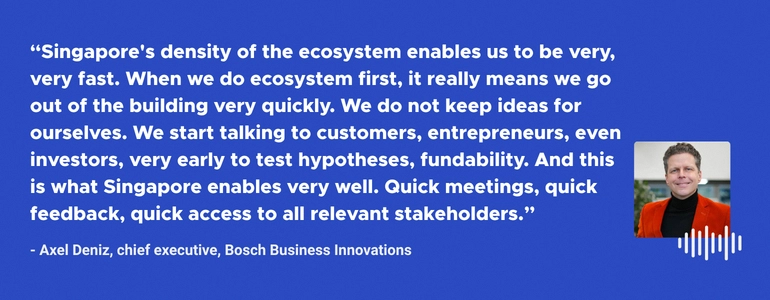
Singapore’s dense ecosystem reduces those disadvantages. Customers, entrepreneurs and investors are in close proximity, so companies get rapid, real-time feedback.
“We’re able to have quick meetings, quick feedback, quick access to all stakeholders,” explains Mr Deniz. “Those early conversations mean we’re not relying on wishful thinking.”
A strong commitment
Much of this momentum is driven by sizeable public-sector investment. Over the next five years, Singapore has committed about US$29bn—about 1% of its annual GDP—to research and development under the Research, Innovation and Enterprise (RIE) 2030 plan. Additional funding has also been allocated to high-priority sectors, such as advanced manufacturing, sustainability, the digital economy and deep-technology ventures.
These commitments signal the kind of long-term predictability that companies prize. This is particularly important in industries where development cycles are long and capital requirements are high, such as deep tech and AI-driven technologies.
Regulation plays a similar role in encouraging innovation, while mitigating risk. In Singapore, businesses can test new ideas in real-world market conditions within clearly defined parameters. For example, in financial services, the FinTech Regulatory Sandbox allows companies to trial new products under regulatory supervision, often shortening their path to market.
Singapore’s rigorous IP regulations give organisations confidence that their ideas will be protected. This is especially important for Bosch, says Mr Deniz, which boasts one of the world’s largest IP libraries. “We have more than 125,000 IP rights, so being in an environment where this strength can come into play is very beneficial for us.”
The city-state’s patent process is swift, which has helped Singapore’s IP regime rank as one of the best in the world. While getting a patent approved could be a two-year process in other markets, it takes just six months in Singapore, Mr Deniz says.
Singapore’s large pool of more than 52,000 researchers, scientists and engineers underpins innovation. This is complemented by sustained investment in STEM and AI to develop and attract the best technology talent. Over S$1 billion (around US$785 million) will be invested into AI research and training over the next five years. While Singapore’s budget for 2026 included funding for a National AI Council to co-ordinate strategy, governance and industry engagement, and dedicated business parks designed to cluster AI startups, researchers and skilled workers.