6
How partnerships in Singapore helped OMRON, and Pratt and Whitney with innovation and growth

How partnerships in Singapore helped OMRON, and Pratt and Whitney with innovation and growth

From aerospace to healthcare, MNCs and local enterprises in Singapore are benefiting from partnerships that help them diversify supply chains, shorten time to market and scale up to serve new customers.

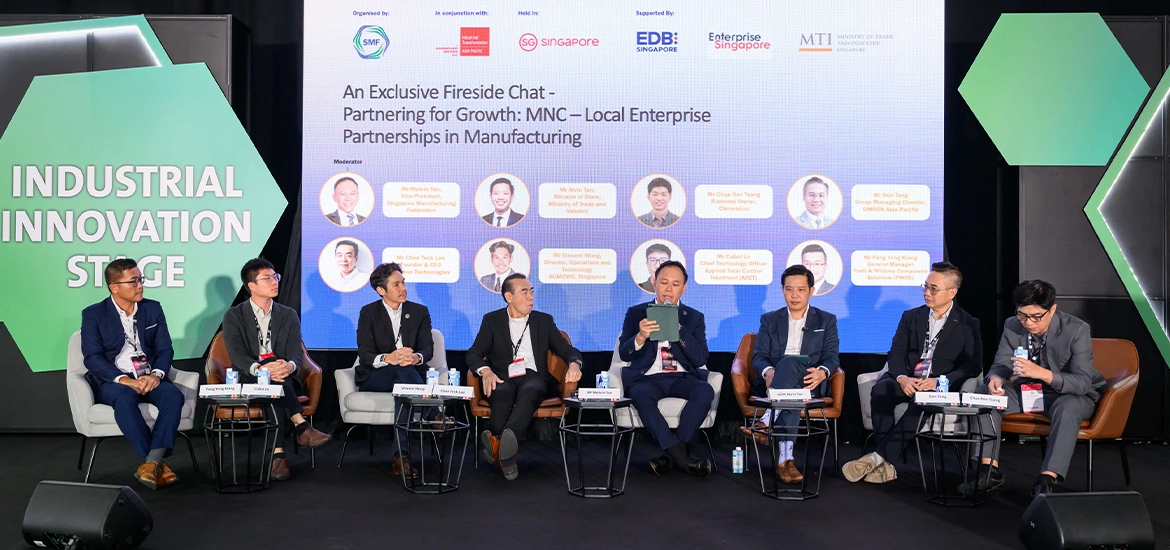
Panel discussion on industrial innovation, featuring business leaders speaking on manufacturing partnerships at a conference stage.

As global companies navigate a more complex global operating environment, expanding supplier networks and investing in local partnerships can help them address current and long-term needs – from entering new markets, to innovating for long-term competitiveness.

At Industrial Transformation Asia-Pacific 2025 (ITAP), Minister of State (MOS) for Trade and Industry Alvin Tan joined executives from OMRON, Pratt& Whitney, ATC Treatments, and Clemvision in a fireside chat moderated by Melvin Tan, Vice President of the Singapore Manufacturing Federation (SMF). Here are the highlights:
 

1. Singapore can be “cheaper, faster, better” for manufacturers that partner with local enterprises

Singapore is a trusted location for businesses, providing easy access to other Asian markets and offering seamless trade connectivity to the rest of the world. It is home to over 350,000 enterprises, including global corporates, local companies and innovative startups.

MOS Tan also highlighted Singapore’s strong local talent pool, with its Institutes of Higher Learning such as Nanyang Technological University (NTU) and National University of Singapore (NUS) training talent through joint R&D programmes tailored to create solutions for real-world problems.

By being at the crossroads of global trade, Singapore can play “a unique role as a trusted connector where multinationals and local enterprises come together to co-create, build capacity, and drive innovation,” said MOS Tan.

The push to diversify supply chains and production sites are creating new opportunities for Singapore businesses to collaborate with overseas companies, said MOS Tan. He also highlighted the Johor-Singapore Special Economic Zone (JS-SEZ) in Malaysia as an ideal platform for many companies seeking to twin their operations, grow their businesses, and develop new capabilities by tapping onto the complementary benefits offered by Singapore’s stable governance and regulatory environment and Johor’s strengths in land and natural resources.

Together with the Batam, Bintan, Karimun (BBK) region in Indonesia, businesses across industries can establish complementary operations in countries neighbouring Singapore, to strengthen their market presence here and abroad. Companies can access competitive natural resources in Johor and BBK and tap on Singapore as a global business hub by anchoring headquarters, R&D and innovation operations here.
 

How the MNC-LE Alliance supports your partnership development

The MNC–Local Enterprise (LE) Alliance (also known as the MNC–SME Alliance) is a strategic platform in Singapore designed to help integrate global corporations with high-potential local firms. Launched by the Singapore Manufacturing Federation (SMF), and supported by EDB and Enterprise Singapore, this initiative moves beyond traditional vendor relationships to focus on strategic co-development and long-term ecosystem resilience.

For decision-makers, engaging with the Alliance is a critical tool for supply chain de-risking, accelerated innovation, and leveraging public funding to drive growth in the Asia Pacific region.

The Alliance is not merely a networking event; it is a structured matchmaking process overseen by  SMF, comprising:

  • Identifying Problem Statements: MNCs define specific technology gaps, supply chain needs, or innovation challenges.
  • SMF Matchmaking:  SMF actively connects your problem statements with vetted, capable local SMEs.
  • Adopting the appropriate Collaboration Models: Partnerships typically fall into three areas:
    • Supplier Development: Integrating SMEs as critical, capable suppliers.
    • Technology Transfer: Sharing knowledge to upgrade local capabilities.
    • Joint Innovation: Co-developing a new product or solution.

While the process can vary in complexity—from a simple product tweak taking three months to a complex regulatory project taking a year or more—the Alliance acts as a facilitator, bringing together the right partners for a successful "win-win" outcome.

Find out how you can be a part of the alliance >>

Read the boxed content below to learn about funding support for partnerships


2. Success stories show the power of collaboration between MNCs and Singapore enterprises

The local enterprises spoke about how partnerships helped them develop new capabilities and access international markets, while the MNCs – in aerospace and healthcare – highlighted their ability to strengthen supply chains and access local and regional know-how:

Aerospace

THE PARTNERSHIP Engine manufacturer Pratt & Whitney collaborated with homegrown enterprise Applied Total Control Treatments (ATCT) to develop high-performance electroplating capabilities for aerospace maintenance and repairs. High-performance electroplating is a process where a thin layer of metal is applied to aircraft components to enhance functionality and durability—against the stresses of corrosion and wear and tear.

WIN-WIN OUTCOMES Pratt & Whitney localised a critical process, reducing turnaround times and decreasing reliance on overseas suppliers.
 

“When we source for local enterprises to collaborate, it’s not just sourcing; it’s not a vendor-customer relationship. We are co-developing that particular repair with them.”

Pang Yong Kiang

General Manager

Pratt & Whitney


The company’s General Manager Pang Yong Kiang said: “ATCT’s agility and commitment and being in the same time zone as us – believe me, being in the same time zone makes a world of difference – really ticked all the boxes. Establishing that strong collaboration and having that local capability on-island made a difference for our customers.”

For ATCT, Chief Technology Officer Cabal Lo described the collaboration as “a turning point” for the company. “It allowed us to meet the expectations of global standards in aerospace through consistency, quality commitment, and compliance with international requirements,” he added.

Healthcare

THE PARTNERSHIP Within the healthcare space, OMRON Electronics partnered with Clemvision,  automation solutions company, to develop a stroke kinetic therapy system combining motion tracking, adaptive therapy, and real-time feedback to personalise stroke recovery.

WIN-WIN OUTCOMES Don Teng, Group Managing Director at OMRON Electronics, explained the strategic value of partnering with local enterprises in Singapore.  “The reason we partner with them is because of their agility, their critical insights, and their deep domain expertise. By combining their motion-tracking capabilities with OMRON’s automation strengths, we realised that we could develop a solution to personalise stroke recovery.”

For Chua Ren Tsong, Clemvision’s Founder and Director, the impact of this collaboration was evident. “OMRON gave us the platform to apply our AI innovation system to the med-tech sector. They provided engineering support, clinical access, and accelerated our growth so that we could scale up with the right global partner.”
 

3. Singapore is catalysing MNC-local enterprise partnerships through connections and co-funding

EDB and EnterpriseSG are working to enable more win-win collaborations through connecting companies, co-funding their partnerships and helping to ease early-stage challenges. For example, the Partnerships for Capability Transformation (PACT) scheme (see boxed content below), helps to outweigh some of the initial partnership hurdles, by defraying part of the costs involved. PACT has been progressively enhanced to ensure it stays relevant and responsive to industry developments and evolving business needs.

EDB and EnterpriseSG have brought together companies to help them better understand each other’s needs and operating models. They are encouraged to start small, through pilot projects that allow them to test compatibility and build trust before committing to deeper, longer-term partnerships.

Industry associations like SMF help connect the government, MNCs, and local enterprises. The latter two provide valuable feedback from the ground, ensuring that Singapore provides businesses with appropriate and relevant support, so that they can stay competitive in a fast-evolving global environment. 

Get support for partnerships in Singapore

Companies looking to explore collaborations with Singapore enterprises can tap into the Partnerships for Capability Transformation (PACT) scheme.

Launched in 2010, PACT helps MNCs, and SMEs localise solutions, enhance supply chain resilience and co-innovate for growth in Asia. More than 2,500 Singapore-based firms have already benefited.

How it works — partnership costs covered under PACT include:

  • Validation of supplier procedures against OEM requirements
  • SME adoption of niche technologies
  • Productivity improvements, knowledge transfer and test-bedding of innovative solutions
  • Joint product development and consortium partnerships
  • Wage support for managers overseeing supplier development and procurement systems

Beyond PACT, companies can also access:

Read more about PACT

Questions? Contact us


Related Content

Subscribe Icon
The latest business insights and news delivered to your inbox
Subscribe now