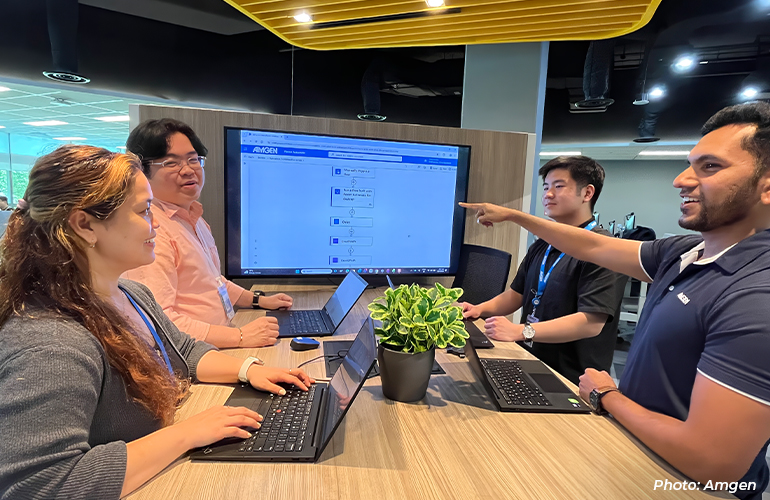
His experience is part of a wider culture of continuous improvement at Amgen, where different teams collaborate to test and improve how digital tools can be applied more efficiently in day-to-day work.
Prior to his current role, Mr Ramasamy worked with his manager in a process-focused role to use Robotic Process Automation to handle repetitive tasks such as data entry and data checks across multiple systems. This freed up staff to focus on higher-value work, including interpreting results and investigating anomalies.
This focus on applied learning – where staff are given the space to explore and apply digital tools to solve real-world problems – is how the company prepares for the future.
Having such a supportive environment is just one of the reasons why Amgen is consistently ranked as one of Singapore’s best employers by global research firm Statista and The Straits Times.
Ms Shobha D’Sa, the company’s human resources director, says: “The pace of change from digital tools, automation, and data-driven decision-making has accelerated. We’ve focused on making learning much more applied and continuous – through structured pathways, rotations, mentoring, and career conversations that help people grow with the work, rather than chase change after it happens.”
The priority, she stresses, is not just adopting the next wave of tools, but also bringing its people along.
As it turns out, this is not something that happens alongside a technology roll-out. At Amgen, a culture of trust and collaboration has to be in place long before the new tools arrived.
Only then do employees speak up, support one another, and take ownership as the pace of change accelerates.
Take senior manager Charlene Peh, for example.
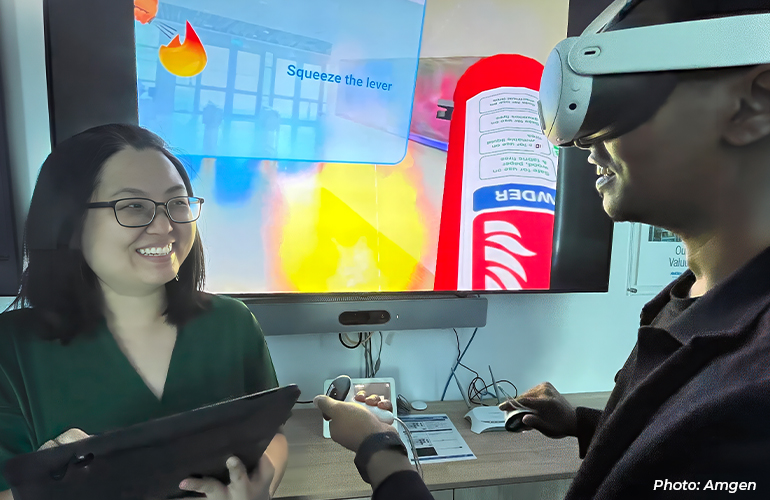
When she noticed that new hires were struggling to stay engaged during classroom-based health and safety training sessions, she worked with external partners and cross-functional colleagues to help develop an immersive safety experience using gamification and virtual reality.
Since early 2026, new hires in Singapore have been able to explore realistic work environments virtually and practise safety responses through simulations and interactive modules on their screens.