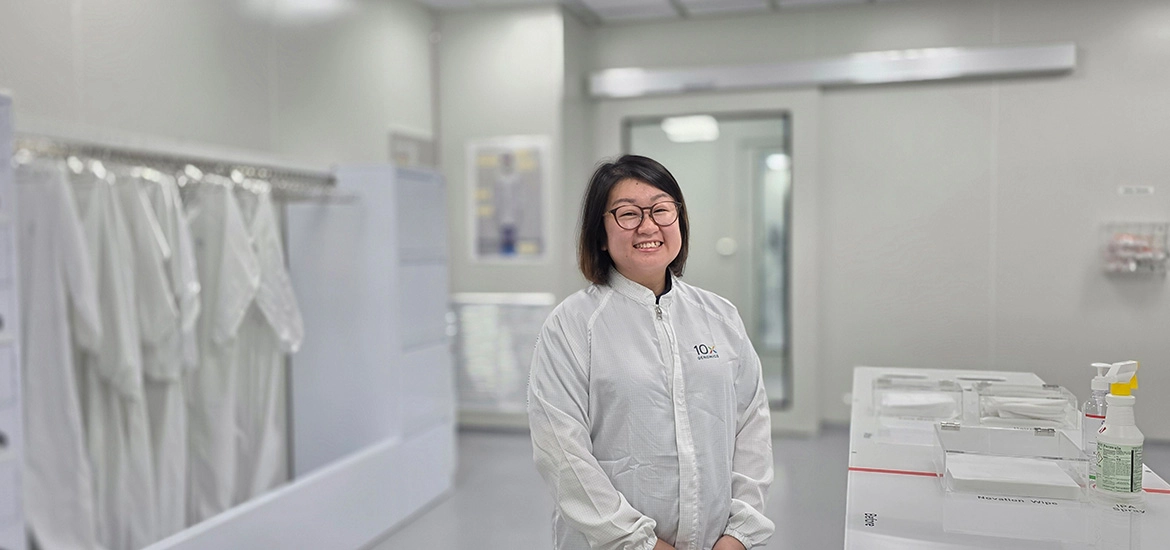
Singapore’s biotech ecosystem has been growing swiftly, alongside the growth of our biomedical ecosystem where companies innovate, manufacture and commercialise beneficial end-to-end solutions and create quality jobs for our local talent. Headquartered in the US, 10x Genomics develops instruments, consumables and software for single-cell and spatial biology, helping researchers and biopharmaceutical companies to study biological systems at an unmatched resolution and scale. The company has established its first manufacturing site outside the US in Singapore, producing consumables that support breakthroughs in oncology, immunology, neuroscience and more, transforming the world’s understanding of health and disease.
1. Tell us more about what 10x Genomics does, and your work as a Senior Staff Scientist.
10x Genomics develops game-changing solutions that allow scientists to analyse thousands to millions of individual cells at once, at a resolution that was previously impossible. This has changed how scientists study and understand diseases, transforming applications from cancer research to drug discovery. Here in Southeast Asia, we are looking to tap into the talent pool and supply chains to scale up the production of our tools, leveraging the ecosystem of biotech companies here with rich expertise in mass volume production.
As a Senior Staff Scientist, I lead a Process Development team of Scientists and Engineers who are responsible for the transfer of new manufacturing processes and technologies from the 10x Genomics headquarters to Singapore, alongside day-to-day production support. The team provides technical oversight to ensure product quality from incoming raw materials to the final products. Much of the work we do requires close collaboration and constant communication with cross-functional teams, from manufacturing and quality control to supply chain.
2. Why did you choose to further your studies in chemistry, and what led you to 10x Genomics?
I did my Bachelor’s in Applied Chemistry at the National University of Singapore and started my career as a Junior Researcher at the Agency for Science, Technology, and Research (A*STAR). The continuous cycle of hypothesising, experimenting, and drawing conclusions - even if they turned out to be negative - was such an engaging experience that led me to pursue a PhD in Organic Chemistry from the University of Cambridge.
By the end of my PhD, I wanted to do more translatable work where I could help to solve real-world problems. That’s how I landed in 10x Genomics, where I gained a deeper perspective on the different functions in a biotech business as I moved from an individual contributor into a managerial role.
3. What are some of the more impactful projects you’ve worked on at 10x Genomics, and what have you learnt through these experiences?
The most impactful project I’ve worked on was during the early days of setting up the Singapore site. It was during the COVID-19 period in 2020-2021, and we were looking to transfer the Gel Bead manufacturing process to Singapore. Gel Beads are an important component in our products, as they carry unique molecular labels that act as tags for genetic material to facilitate single-cell research.
The high level of precision and complexity needed for Gel Bead manufacturing meant that we had to grapple with many unknowns and challenges at the new site. Due to the pandemic, we were also limited to video communication. Through countless tech talks and sharing sessions with the HQ team, we successfully facilitated the transfer of the Gel Bead manufacturing process. It was a huge milestone for our local site, and we continue to grow our knowledge of this important product in Singapore. Today, 100% of Gel Beads supplied worldwide by 10x Genomics are manufactured from the Singapore site.
Through this experience, I learnt to keep an open mind to adapt to the fast pace of the industry. When things move fast, there will be many opinions thrown your way, but curiosity and humility will help you to hear opposing opinions, better understand stakeholders’ interests, and look at each problem objectively. Since communication spans different levels and functions, I’ve also learnt the importance of translating complex technical issues and theories into something that can be easily understood by the general audience.