6
Jobs in Singapore: “How I’m shaping the next wave of smart home and Internet of Things innovations globally”

Jobs in Singapore: “How I’m shaping the next wave of smart home and Internet of Things innovations globally”

From being a polytechnic lecturer to a stint in the Prime Minister’s Office, Dr. Keith Cheng Jialiang has been making an impact in different sectors. Now he’s combining his experience to take consumer innovation to the next level.

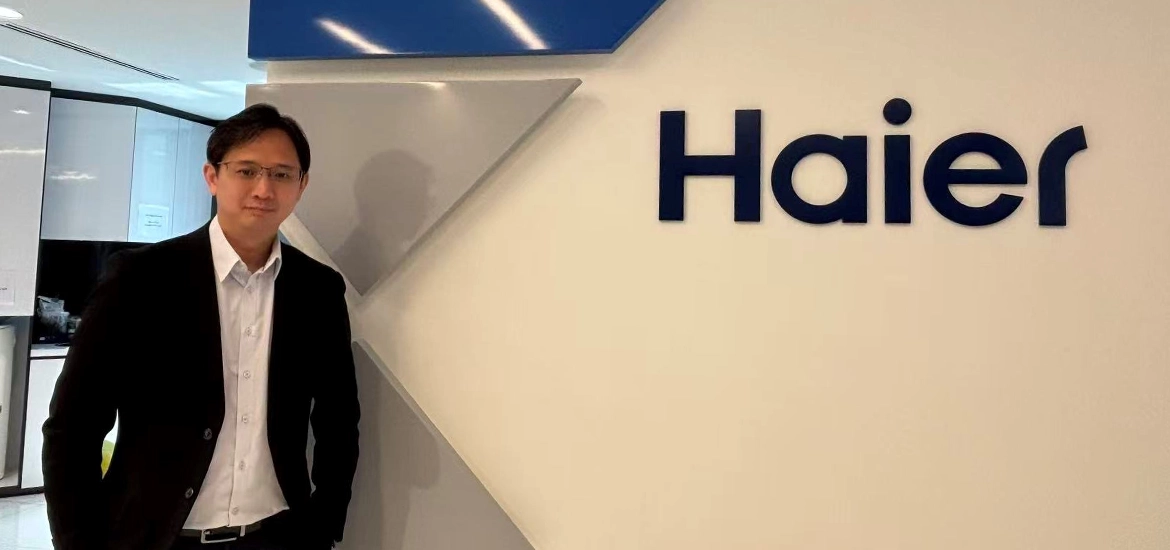
A man in business attire standing beside a wall with the Haier company logo inside a modern office setting.

Dr. Keith Cheng Jialiang is the Director of the Haier Singapore Innovation Centre. A Chinese MNC home appliances and consumer electronics company, Haier has its regional headquarters in Singapore, where it operates a worldwide innovation ecosystem through its HOPE (Haier Open Partnership Ecosystem) platform — collaborating with startups, research institutes, and universities to co-develop next-generation solutions. Dr. Cheng has a Bachelor’s Degree in Materials Engineering and a Doctor of Philosophy in Materials Science and Engineering from the Nanyang Technological University.
 

1. Tell us more about Haier’s presence in Singapore and what you do in your current role.

Haier was established in Singapore in 2011 — this is the regional headquarters for the group’s overseas business. Our products can be found in over 100 countries, and from here, we manage operations across Asia, Europe, and the Americas, so you can consider Singapore to be the nerve centre for Haier’s global setup. The focus here is about driving global coordination, from R&D and procurement to sales and digital transformation.

We’re big on innovation, and that’s where the Haier Open Partnership Ecosystem (HOPE) platform comes in. The goal is to establish an open innovation ecosystem, where we can connect with industry partners, universities, and startups to co-create new technologies that can meet business and consumer needs.

I serve as the Director of the Haier Singapore Innovation Centre, which is the overseas arm of HOPE. Think of the Singapore centre as the company’s radar for new ideas and technologies by scouting for solutions that can address real-world problems in areas like smart homes, energy efficiency and new materials, and running joint research projects. My team helps identify the right collaboration partners and assesses the potential of emerging technologies before matching suitable innovations with our product lines or industrial needs. It’s not just about discovery; it’s about making innovation tangible and integrating it back into Haier’s ecosystem so we can adapt to what users want and how they live — that’s how the company has managed to stay competitive for so long.


2. What made you decide to join Haier?

Haier stood out to me when I was looking to get some solid corporate experience in an MNC environment, due to its strong international presence and innovation-driven culture. This role has been a great opportunity to learn, grow, and see how innovation happens on a global scale, which is a huge part of Haier’s DNA. 

What gives Haier its edge is the combination of global reach and local insights. We bring innovative research insights to our global teams and translate them into tangible solutions with our resources. This enables us to turn good ideas into products that can help make life better for consumers. At Haier, we don’t just make appliances; we’re building connected, intelligent ecosystems for the home.


3. You’ve been in a variety of roles across different sectors. What led you to those career switches and how did you navigate the transition between each job?

I started off in research and academia, doing very hands-on work focused on materials development and lab experiments, and from this experience, I learnt how to think critically and handle uncertainty. Experiments or innovative ideas rarely work the first time, so you pick up patience, persistence, and a structured way of solving problems. During my PhD, I had the opportunity to work on a defence-funded materials project — that was my first taste of applying research to solve real-world problems.

I wanted to see how ideas could make a real impact beyond the lab and this pushed me to move into the public sector, where I got the chance to work on national R&D strategy and policy. My work saw me coordinating big-picture initiatives in sustainability, energy, and technology across agencies through the National Research Foundation and the Strategy Group in the Prime Minister’s Office. It gave me a broader view of how innovation gets supported and scaled at a national level to shape industries.

After that, shifting into the corporate world at Haier felt like a natural next step. It was a chance to bring everything together — the technical depth from research and the strategic thinking from the public sector — and apply it in a fast-paced, global business environment. Navigating these transitions wasn’t always easy, but the common thread was staying open to learning, building bridges between different worlds, and keeping that curiosity to see how science can drive tangible change.


4. What advice would you give to younger professionals about “future-proofing” their career?

Be curious, adaptable and be clear about your purpose.

These three qualities have helped me to stay relevant. I’ve always wanted to see how things work from different angles, and being inquisitive has led me to where I am today. Being adaptable is necessary because every transition into a new industry means learning a whole new language. Having a sense of purpose is also critical — at the end of the day, it’s your purpose that will drive you to achieve greater heights in your career. For me, I’ve always tried to connect science and innovation to something that creates real impact, whether it’s through national R&D programmes or global projects at Haier.

Lastly, you need to be willing to learn. The world’s moving fast, so you’ve got to be open to new ideas and not be afraid to start from scratch when you switch paths. Good communication also goes a long way, especially when it comes to being able to explain ideas clearly to different people, whether they’re engineers, policymakers, business teams, or partners from different countries and cultures.
 

“To fresh graduates: don’t worry if you don’t have everything figured out yet. Engineering gives you a strong foundation to explore different paths, whether it’s in R&D, policy, or even business. Stay curious, keep learning, and don’t be afraid to get your hands dirty. The more you try, the clearer your direction will become.”

Dr. Keith Cheng Jialiang, 43

Director

Haier Singapore Innovation Centre


5. You’re a materials engineer by training. Why do you think engineering is an exciting field for Singaporeans to be in, and what advice do you have for fresh graduates looking to pursue a career in the field?

Materials science can be considered to be foundational for engineering because it’s about understanding what things are made of and how we can make them better. We look at how the structure of materials — like metals, ceramics, or polymers — affect their properties and performance. In simple terms, it’s about understanding how to design and improve the materials we use every day, like developing coating materials that make appliances easier to clean, or creating better insulation materials that help fridges stay cool while using less energy. It’s a very practical field driven by problem-solving, and in that vein, engineering is exciting because it’s everywhere — it’s what keeps our cities running, powers our homes, and shapes the tech we use every day. In Singapore, where innovation and sustainability are big focus areas, engineers are right at the heart of solving real problems, from green energy and smart cities to advanced manufacturing.

To fresh graduates: don’t worry if you don’t have everything figured out yet. Engineering gives you a strong foundation to explore different paths, whether it’s in R&D, policy, or even business. Stay curious, keep learning, and don’t be afraid to get your hands dirty. The more you try, the clearer your direction will become.
 

Related Content

Subscribe Icon
The latest business insights and news delivered to your inbox
Subscribe now