6
Advanced manufacturing in Singapore: Built for what’s next

Advanced manufacturing in Singapore: Built for what’s next

Purpose-built infrastructure, deep R&D capabilities, a network of partners, skilled talent, and government support – when it comes to high-tech, complex manufacturing, Singapore is where next-gen products are being designed, built, and scaled.

An indoor garden featuring a large central waterfall beneath a glass-domed roof, surrounded by lush greenery.

As a leading hub for semiconductors, biomedical sciences, aerospace, and specialty chemicals, Singapore’s manufacturing sector is diverse, technologically advanced, and deeply integrated into global supply chains.

Underpinning this is a combination of factors that global manufacturers consistently cite: a trusted and stable operating environment, world-class infrastructure, deep R&D and innovation capabilities, a robust ecosystem of industry and innovation partners, connectivity to global markets, and skilled talent. Singapore also has an extensive network of 29 free trade agreements that provides easy access to major economies, and serves as a gateway to the fast-growing Asian region.

Here’s what Singapore offers:
Purpose-built infrastructure for cutting-edge manufacturing operations

Think of Singapore’s industrial landscape as a series of interconnected nodes – each engineered for a specific sector, linked by shared infrastructure, integrated logistics, and a density of partners that makes collaboration easy.

By clustering complementary industries around sector-specific facilities, Singapore creates vibrant ecosystems where businesses accelerate the entire manufacturing journey from prototyping to production.

Managed by JTC, Singapore’s public agency for sustainable industrial estates, these spaces come equipped with the essentials – reliable power, water, waste management, and high-speed connectivity – so you can focus on production from day one.
 

Jurong Innovation District (JID) is Singapore's next-generation industrial estate, purpose-built for businesses shaping the future of advanced manufacturing. Spanning five interconnected precincts, JID brings together an ecosystem of research institutes, capability developers, technology and training providers, and factories of the future, supporting the entire manufacturing journey.

Bulim Square, completed in October 2025, is the latest addition to JID. It adds over 1.2 million sq ft (that’s equivalent to 90 Olympic-sized swimming pools) of purpose-built factory space. Designed as a car-lite district, Bulim Square features the world’s first 11km Sky Corridor and underground District Logistics Network, enabling seamless movement of goods while reducing surface traffic and enhancing operational efficiency.

Punggol Digital District is a smart and sustainable district for key technology sectors, hosting companies in AI, robotics, cybersecurity, and FinTech. It is Singapore’s first business park designed to integrate with the Singapore Institute of Technology campus, bringing together academia, industry associations, government agencies, and businesses to conceptualise, testbed, and scale new ideas and solutions.

Jurong Island is one of the world’s largest chemicals export hubs with a powerful mix of refining, olefins production, chemicals manufacturing, and R&D from over 100 top energy and chemicals firms.

With the global energy transition and the emerging demand for sustainable products, the island’s refreshed direction builds on scaling new energies and pioneering low-carbon technologies whilst growing Singapore’s capabilities in specialty chemicals and sustainable materials.

One-North is an established research and innovation district comprising eight distinct precincts. To date, the research and business park is home to a dense ecosystem of over 400 leading companies, 15 research institutes, and six institutions of higher learning and corporate universities. It is also home to LaunchPad @ One-North, a dedicated seven-block space for startups, incubators, accelerators, and venture capital firms, and Stage One, which provides business support to startups who land in Singapore.

  • Semiconductor wafer fab parks (WFPs) – Spanning 391 hectares (that’s equivalent to over 3,120 Olympic-sized swimming pools!) across four parks, WFPs provide facilities to meet the semiconductor industry’s most stringent requirements. To date, the parks house 14 global semiconductor companies, including Global Foundries, Micron Technologies, SSMC, STMicroelectronics, and more.
  • Tuas Biomedical Park (TBP) supports pharmaceutical and MedTech companies with tech-intensive manufacturing activities, from antibiotics and vaccines to 3D implants and active pharmaceutical ingredients. Located in the western part of Singapore, TBP hosts over 8,000 employees and 19 biomedical and nutraceutical MNCs, including global industry leaders such as Merck, Pfizer and Wyeth.
  • Seletar Aerospace Park (SAP) is Asia’s leading aerospace hub. Home to over 80 industry players, SAP supports engine and component manufacturing, Maintenance, Repair and Overhaul (MRO), R&D, and training.

Woodlands Gateway is Singapore’s northern gateway to the JS-SEZ. Spanning up to 35 hectares, the district provides flexible industrial and office spaces that will cater to firms siting manufacturing functions in Johor, with regional headquarter functions in Singapore. The first phase of Woodlands Gateway is expected to be completed around 2030.

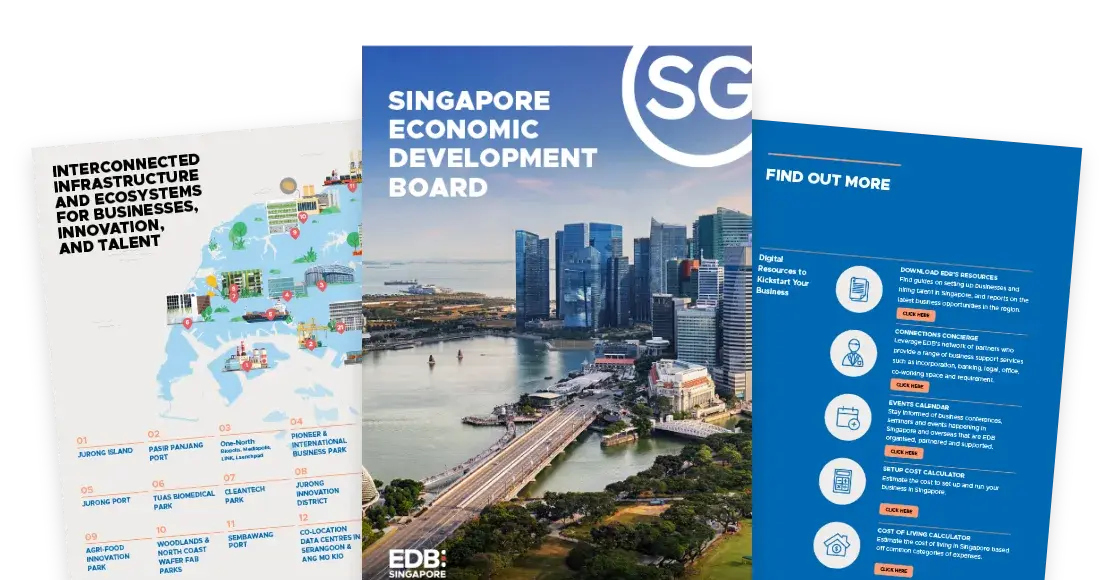
JTC key estates infographic

Learn more about JTC's key estates here.


Robust innovation and R&D capabilities to drive your next breakthrough

From AI-enabled predictive maintenance to 3D-printed ship propellers, Singapore’s R&D ecosystem is built to turn your ideas into breakthrough innovations, fast.

Singapore has consistently invested at least 1 per cent of GDP into Research, Innovation and Enterprise (RIE). The recently announced RIE2030 masterplan will see S$37 billion set aside for key advanced manufacturing areas such as semiconductors, biomedical sciences, sustainability technologies, and quantum computing.

When it comes to on-ground support, the Agency for Science, Technology and Research (A*STAR), Singapore’s lead public sector agency for R&D, and Enterprise Singapore, the public sector agency accelerating local firms’ global expansion and innovation, are crucial. They run various national platforms and programmes that give manufacturers direct access to expertise, R&D infrastructure, technology partners, and testbeds to support research translation and commercialisation.
 

Bridging the “valley of death” in tech translation, A*STAR ARTC brings together over 90 industry consortium members – including MNCs, global tech providers, and local enterprises – to co-create and deploy factory-ready solutions in an industrial-scale sandbox.

To date, they have rolled out over 100 advanced manufacturing solutions, such as autonomous systems and robotics, intelligent inspection, and industrial AI, delivering measurable gains in productivity and cost efficiency.

For example, Coca Cola’s Commercial Product Supply facility in Singapore introduced automation and digital tools through co-innovation with A*STAR ARTC. This boosted labour productivity, set the blueprint for deployment across Coca-Cola's global network, and contributed to the facility’s recognition as a World Economic Forum (WEF) Global Lighthouse.

By developing new technologies and transferring them to the manufacturing value chain, A*STAR SIMTech leads partnerships that build strong manufacturing capabilities in Singapore enterprises, enabling them to become trusted partners and suppliers to MNCs.

For example, local surface treatment specialist Applied Total Control Treatment gained new manufacturing capabilities through a technology transfer, taking on the repair and refurbishment of Singapore Airlines’ cabin components.

Supporting manufacturers in co-developing and deploying AI-enabled solutions in operating environments, AIMfg draws on A*STAR’s strengths in areas such as Computer Vision, Generative AI, and Large Language Models.

For example, AIMfg has developed AI common models, which are pre-trained foundation models catered to typical manufacturing use cases. Companies can fine-tune these models with their own data to accelerate deployment, saving time and effort. Another example is AIMie, an agentic AI system, demonstrates how human-AI collaboration can enhance predictive maintenance and planning, pointing the way towards more intelligent, resilient factories.

NAMIC supports industry partnerships among Singapore-based manufacturers, global industry leaders, and research institutes, while providing access to infrastructure and talent. It helps accelerate the commercialisation of deep-tech solutions across sectors such as biomedical sciences, aerospace, marine and offshore, and the built environment.

NRP drives robotics and embodied AI innovation through industry-led projects and ecosystem-building. Through its RoboNexus programme, high-potential, Singapore-based companies gain access to leading tech partners, expert business advisory, mentorship, and global opportunities. NRP’s RoboCluster initiative connects end-ussers, solution providers, and researchers to bring innovative solutions to market.

Through OICs, companies are invited to address real-world challenge statements set by MNCs, with funding support for co-development and pilots.

The challenges offer manufacturers access to novel solutions, while solution providers benefit from industry networks, mentorship, and opportunities to validate their ideas in real-world environments.

For example, the recently launched Aerospace OIC 2026 brings together five leading aerospace corporations presenting challenge statements spanning the aerospace and space technologies, in areas such as automation, MRO capabilities, and sustainable technologies.

To further advance our ambitions, Singapore has announced in Budget 2026 its vision to establish an AI-empowered manufacturing sector.

Through the AI Mission for Advanced Manufacturing, Singapore will leverage AI to achieve best-in-class manufacturing facilities, create first-in-world solutions, and drive broad-based sectoral deployment for productivity transformation.


A network of ready partners for high impact collaborations

No manufacturer operates alone. In Singapore, you don’t have to. The advanced manufacturing ecosystem here is underpinned by a diverse base of partners – from contract manufacturers and local suppliers to industrial automation and precision engineering companies. These partners enable MNCs to diversify supply chains, enhance operational resilience, and shorten time-to-market for products and services that are customised for both the regional and international markets.

Read about some successful partnerships between MNCs and Singapore companies:

Through the Aerospace OIC, Antomation, a local startup which uses AI to automate aerospace operations, collaborated with Airbus to develop Cargo Cobra – an automated baggage and cargo handling system.

Cargo Cobra uses machine vision and snake-inspired flexible loading technology to navigate tight spaces and streamline cargo operations. As air travel continues to grow and labour shortages remain, technologies such as these improve worker safety, speed up aircraft turnaround times, and help airports, airlines, and ground handlers reduce operating costs once commercialised.

Since 2010, local firm Meiban has been a manufacturing partner to the world’s leading heart valve products manufacturer, Edward Lifesciences.

For Edwards, the partnership has resulted in improved speed-to-market and significant cost savings. Meiban’s well-established engineering and tooling setup and business strategy aligned well with Edwards’ operational needs. For Meiban, the collaboration was a chance to establish the Singapore-based firm in the medical devices industry.

The partnership between both companies gradually evolved to include Edwards’ New Product Development team, and the co-design and development of new tooling to support Edwards’ Surgical Heart Valve and Critical Care business units. Discover their success story here.

Established in 2017, the Smart Manufacturing Joint Lab (SMJL) by A*STAR, Rolls-Royce, and Singapore Aero Engine Services Private Limited (SAESL) aims to strengthen Singapore’s position as an aerospace MRO and manufacturing hub.

To date, it has deployed 18 advanced technologies at Rolls-Royce's fan blade facility and SAESL’s MRO operations, delivering over 20 per cent productivity gains and helping local aerospace firms enter global supply chains.

The SMJL has engaged over 200 Singapore SMEs, generating S$4.5 million in immediate business opportunities, and enabled eight enterprises to qualify as approved vendors.

When it comes to recycling electronic waste (e-waste), the process is typically tedious and complicated. SK tes, a global leader in sustainability technology solutions addressed the inefficiencies of e-waste recycling by partnering Singaporean automation and robotic engineering solutions provider, Aubotic Technology. The collaboration aims to help ensure accurate and optimised recovery of valuable materials and components, while enhancing worker safety.

The partnership deployed next-gen robotic technologies that resulted in approximately 40 per cent increase in SK tes’ recycling efficiency, strengthened the sustainability leader’s global operations. For Aubotic, working with SK tes enhanced its business portfolio and capabilities. Read about the win-win outcomes of their partnership.


Access to regional resources to optimise your operations and processes

Looking beyond the borders, you can also leverage complementary strengths of Singapore and the neighbouring regions to scale operations and unlock growth across Southeast Asia.

Singapore, along with its strategic location, talent pool, and strong IP protection laws, serves as a trusted base for global and regional headquarters, R&D, and innovation. While the neighbouring regions offer abundant resources, a skilled and cost-competitive workforce, and a growing industrial base, ideal for siting larger-scale manufacturing and digital operations.

For manufacturers, this “twinning” strategy enhances resilience and agility as they expand their footprints and tap on new opportunities in Southeast Asia – one of the world’s fastest-growing economies.
 

Launched in January 2025, the JS-SEZ is a bilateral initiative between Singapore and Malaysia to deepen economic integration and attract global investment. The JS-SEZ spans over 3,500 km2 – over four times the size of Singapore – and covers Southern Johor, including the Iskandar Development Region and Pengerang.

Singapore has established a JS-SEZ Project Office to support Singapore-based companies with administrative matters and business expansion into Johor. Learn how the JS-SEZ region can benefit your business.

Cross-border connectivity is also improving – the Rapid Transit System (RTS) between Singapore and Johor is expected to boost mobility by end-2026 and passport-free QR clearance has been introduced at land checkpoints.

BBK is home to over 20 industrial parks, with recent emphasis on low-carbon estates tailored for advanced manufacturing and data-intensive activities. These include the Sembcorp Tembesi Innovation District, which is linked to a solar facility of up to 200 megawatts.

BBK is home to over 20 industrial parks, with recent emphasis on low-carbon estates tailored for advanced manufacturing and data-intensive activities. These include the Sembcorp Tembesi Innovation District, which is linked to a solar facility of up to 200 megawatts.

Read more about what the BBK region offers Singapore-based businesses.

Skilled talent pool to advance your business

Singapore is home to top-ranking universities, polytechnics, and technical institutes – producing a steady pipeline of skilled talent in engineering, applied sciences, and advanced manufacturing disciplines.

These institutions work closely with industry partners on curriculum development, student internships, staff attachments, and joint projects to ensure graduates are equipped with industry relevant skills. 2023 saw a total of 15,000 STEM graduates from local institutions and polytechnics.

For companies already in Singapore, a range of upskilling and workforce transformation programmes are available for in-employment talent. These include:

These programmes ensure that the manufacturing workforce continues to evolve alongside the sector’s technological demands.
 

Here’s what you need to get started

Beyond infrastructure, innovation, and talent, Singapore offers a range of grants and incentive schemes to support manufacturers at every stage – from initial market entry to expansion and capability upgrades.

Tax credits for companies to undertake substantive and high-value economic activities in Singapore. Download factsheet here.

Supports companies’ technology development and innovation activities, to bring about the development of product and processes from Singapore.

Promotes mutually beneficial collaborations between companies that generate economic value capture through capability building, knowledge transfer or access to new markets. Learn more here.

Supports industrial facilities undertaking projects to improve energy efficiency and reduce carbon emissions. Download factsheet here.

Provides tax incentives for high value-added manufacturing activities in Singapore. Download factsheet here

Manufacturers can also partner agencies like:

Get connected to get started.
 

Related Content

Subscribe Icon
The latest business insights and news delivered to your inbox
Subscribe now