Koh Chiap Khiong, president and CEO of Gas and Related Services at Sembcorp Industries, recalls taking a boat to and from Jurong Island. “Everyone had to get off work on time, because if you missed the boat back, that’s it,” he joked.
Those were the days before the “causeway” between the Singapore mainland and Jurong Island was built.
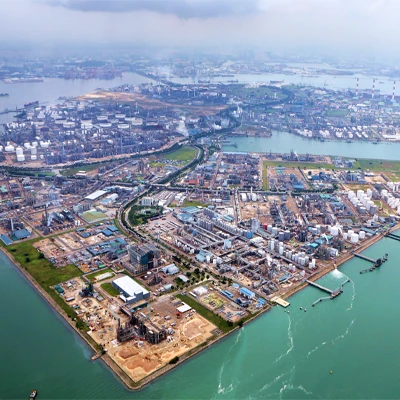
Back then, the environment on Jurong Island was harsh and construction was everywhere. From seven reclaimed islands to a 3,000-hectare integrated hub home to over 100 energy and chemicals companies, the island has since transformed.
But for many like Chiap Khiong, what made Jurong Island work was not just infrastructure but the kampung1 spirit: a shared culture of community, collaboration, and partnership.
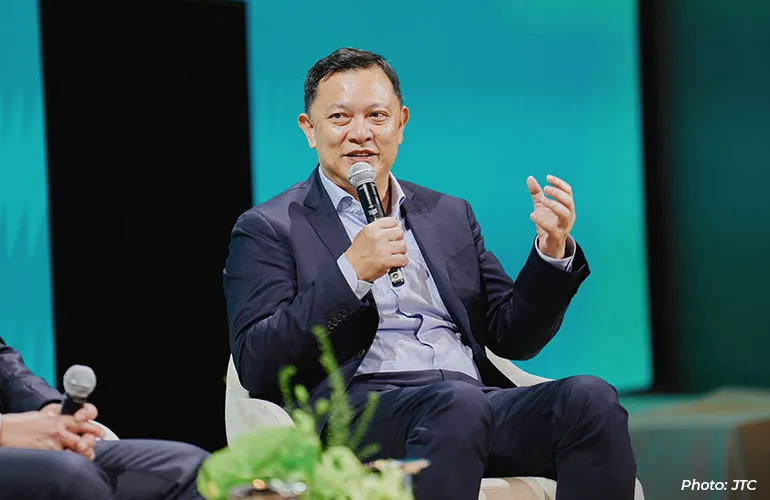
At the Jurong Island 25th Anniversary Dinner held on 24 November 2025, Chiap Khiong, Claus Rettig, interim CFO and Asia president at Evonik, and Andre Khor, group CFO and deputy CEO at Aster, discussed the role of Jurong Island in a low carbon future. The three executives, who have witnessed the island’s transformation from petrochemical powerhouse to a specialty chemicals and sustainable materials hub, recounted the early days on the island and the valuable partnerships formed over the years. The panel was moderated by Josephine Moh, senior vice president of Energy & Renewables at EDB.
Jurong Island’s “kampung” spirit – an ethos of collaboration
In the 1980s, at the turn of Singapore’s industrial manufacturing phase, the Singapore government had a bold idea – to create a thriving, integrated hub for energy and chemicals from seven small southern islands. The newly formed island was envisioned to anchor a new engine of Singapore’s industrial growth. From its early days, Jurong Island brought together local champions like Sembcorp and the Singapore Petroleum Company, and global giants like Shell, Sumitomo Chemical, and ExxonMobil (then known as Esso).
Sembcorp was one of the companies that started as a utilities provider on the Island. Chiap Khiong, who was the Finance Head of Sembcorp’s utilities business then, said being on Jurong Island meant staying connected with all their customers who were also on the island.