With global buyers in the voluntary carbon market increasingly preferring nature-based carbon credits, Southeast Asia (SEA) presents ready opportunities in nature conservation and restoration. This market preference continues to drive significant growth potential for Nature-based Solutions (NbS) in the region.
HAMERKOP’s investment cost analysis across Indonesia, Malaysia, Thailand, Cambodia and the Philippines reveals three key insights to the financial parameters and untapped potential of the region’s NbS landscape, highlighting where firms and investors can capture value:
1. Project costs and national mitigation potential1 related to NbS vary widely.
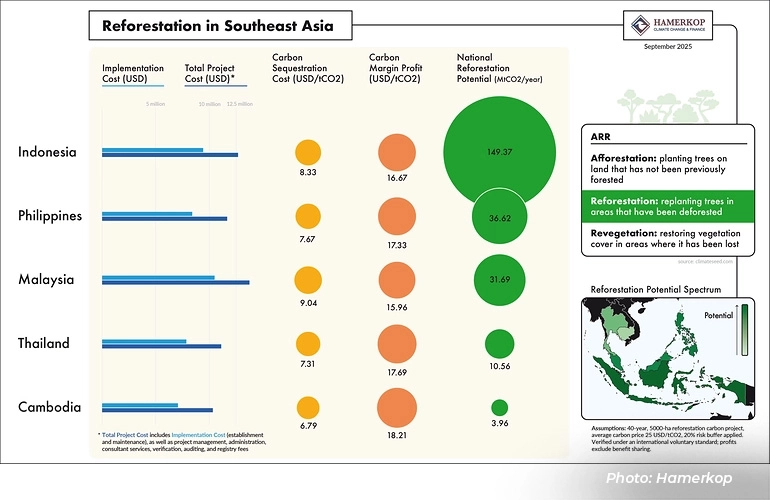
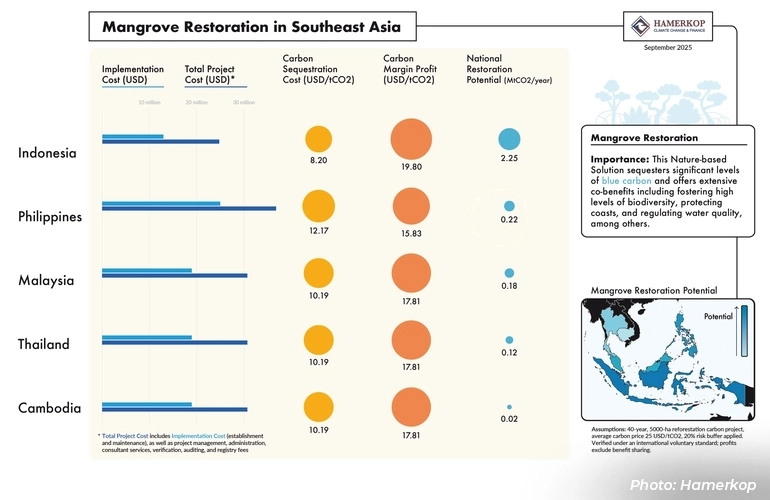
For a representative 5,000-hectare and 40-year project, on-land reforestation requires US$10 to 14 million and sits within national mitigation potential of 3.96 to 149.37 MtCO2 per year, while mangrove restoration requires US$25 to 37 million for national mitigation potentials of 0.02 to 2.25 MtCO2 per year.
2. Current NbS issuance captures only a fraction of available potential.
As of April 2025, cumulative issuance amounts to approximately 12,500 afforestation/reforestation (A/R) credits and around 0.4 million credits from mangrove restoration projects across VCS, Gold Standard, and T-VER. By contrast, the mitigation potential across the five focus countries is estimated at around 232.2 million tCO2e per year from A/R and approximately 2.8 million tCO2e per year from mangrove restoration, highlighting a sizeable supply gap and strong investment runway for early movers.
3. Investment in carbon projects can generate positive economic value under appropriate cost and pricing conditions.
Indicative carbon profit margins point to approximately USD 15.96 to 18.21 per tCO2 for on-land reforestation (at a market price of US$252) and USD 15.83 to 19.80 per tCO2 for mangrove restoration (at a market price of US$28). The profit margins are influenced by multiple factors, including country-level costs, spending timing, project areas, carbon sequestration rates, and carbon pricing.
Situated at the heart of SEA, Singapore provides access for firms interested in developing, financing, and rating the region’s vast NbS supply potential. Singapore’s strategic location, combined with its research ecosystem and policy support for climate finance, positions it as a natural base for firms seeking to develop, finance and verify SEA’s NbS projects. The Southeast Asia Climate and Nature-based Solutions (SCeNe) Coalition and other regional partnerships further strengthen Singapore’s role in contributing to the advancement of high-integrity NbS development in the region.